This post contains affiliate links. As an Amazon Associate we earn from qualifying purchases, at no extra cost to you. Read our disclosure.
Safety first: Always supervise little ones, and skip small parts for kids who still put things in their mouths. Please read our play safety notes before you start.
Key takeaways
- One free 10-page PDF: a morning, an after-school and a bedtime strip, each blank and pre-filled, plus 48 picture cards and a 3-step starter page.
- Start with one strip and 3 steps for the first week. Add a card only when your child does the steps without a reminder.
- Every card is a plain drawing with a word under it, so it works for kids who cannot read yet and for early readers.
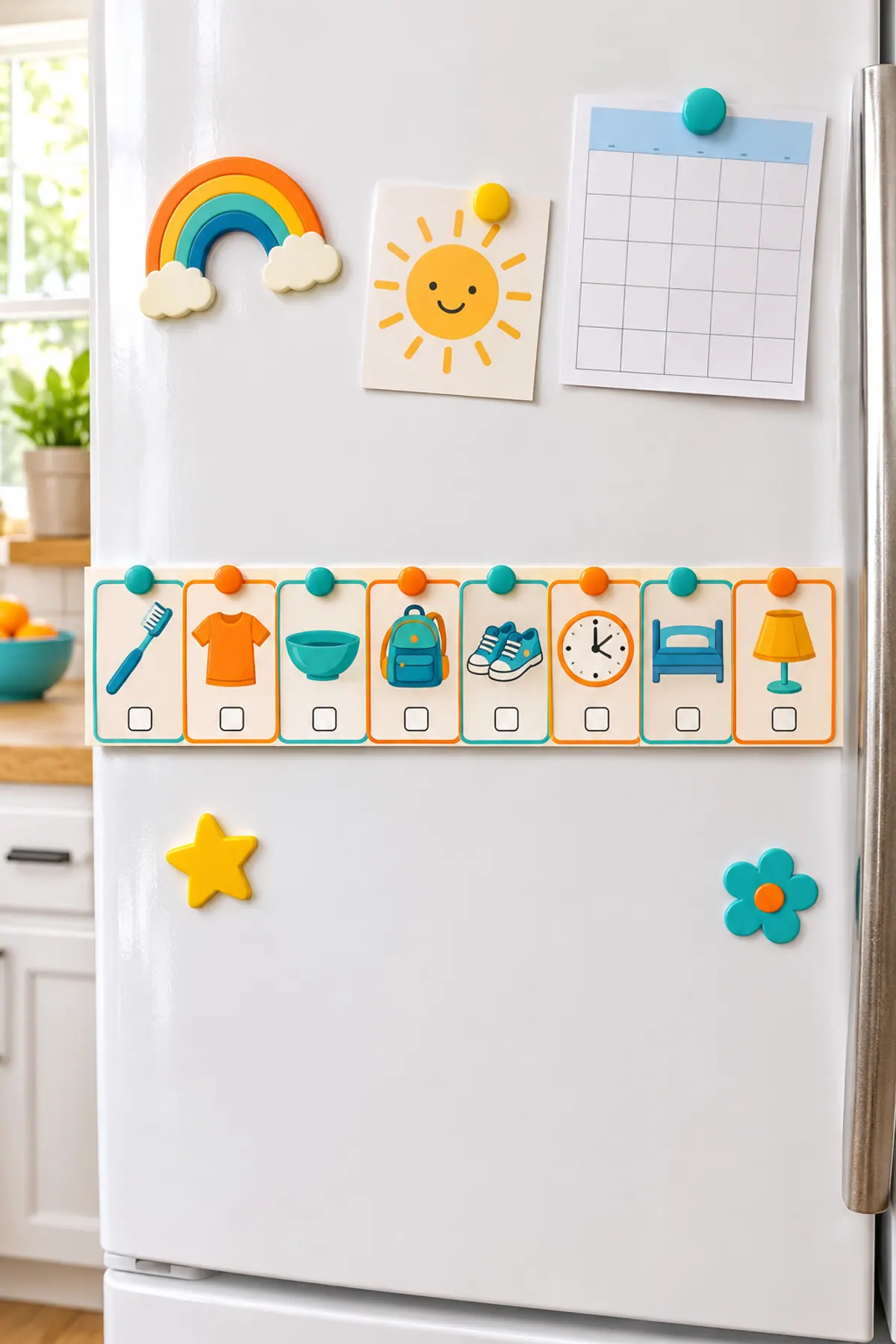
- Stick the strip at your child's eye height where the step happens: the bedroom door, the hooks by the front door, the wall by the bed.
- A grown-up cuts for ages 3 to 4 and stays close during bath time and snacks. Keep cut pieces and velcro dots away from children under 3.
In this post16 sections
- What is in the free visual routine chart
- Which strip first: morning, after school or bedtime
- 1. The morning strip: out the door without the fifth reminder
- 2. The after-school strip: the hour between the front door and dinner
- 3. The bedtime strip: bath to goodnight, calm steps last
- How to set up a visual routine chart in one evening
- 4. Cut and stick the cards for a strip that is yours
- A visual routine chart for kids who can't read yet
- Start with 3 steps, not 8
- A 14-day visual routine reset for January
- Make the strips last: laminate, dry-erase and low ink
- 5. Slide it into a dry-erase pocket
- 6. Print it in black and white
- When a visual routine chart does not work
- When the free strips are not enough
- FAQ
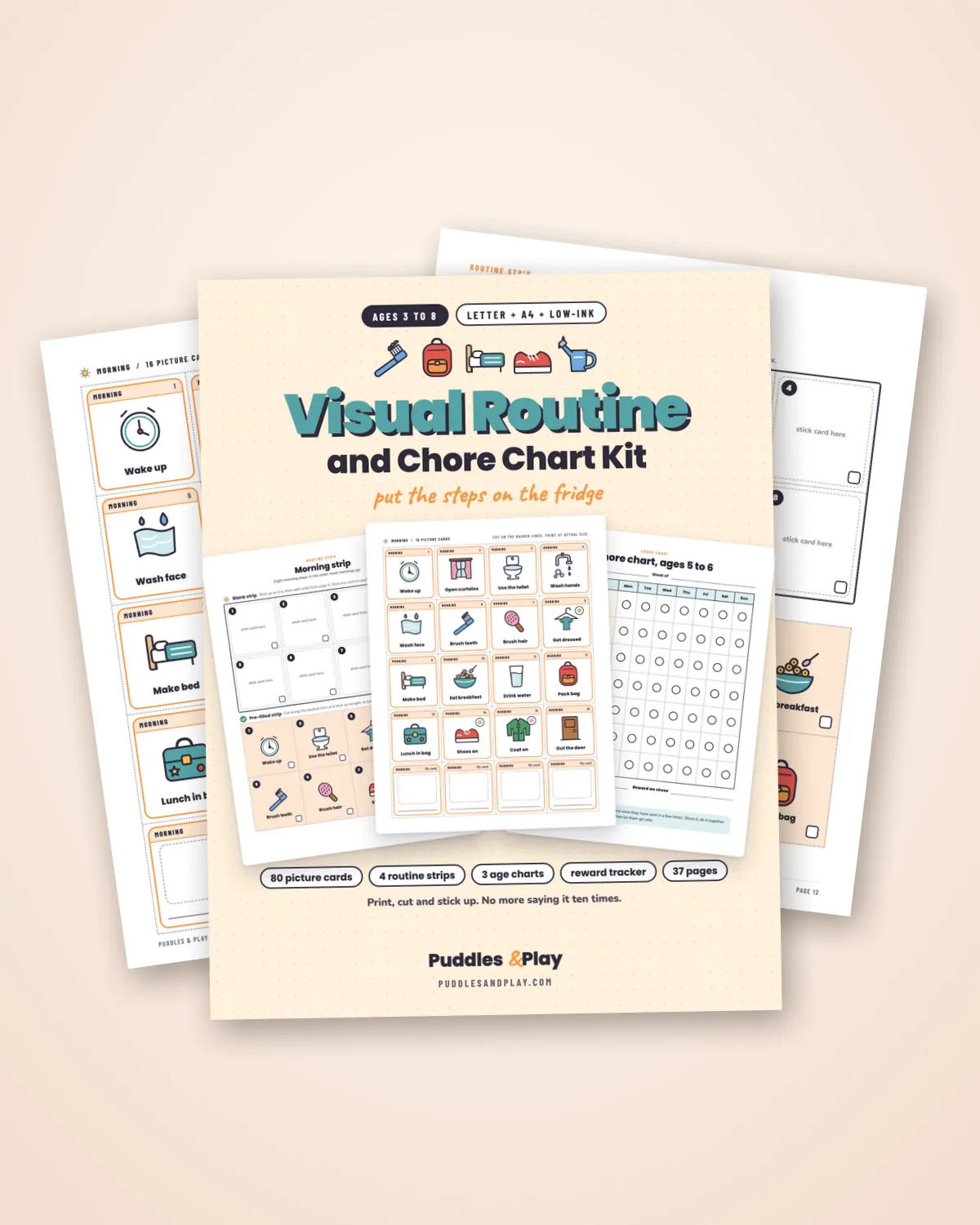
If your free strip works for a week and you want a getting-dressed strip, chore charts by age and a bigger set of cards, the Visual Routine and Chore Chart Kit is the next step for that exact problem: $7 for 37 pages with 80 picture cards, 4 routine strips, 3 chore charts by age and a reward menu, in US Letter, A4 and low-ink files.
What is in the free visual routine chart
The download is 10 pages on US Letter paper. It is built for one job: put the steps of a hard part of the day where your child can see them, so you can point instead of repeat.
Download the free visual routine chart for kids (PDF, 10 pages). Teachers may print copies for their own class. Every picture is a plain drawing of an object, with no people and no faces, and a word under each one for early readers.
| Pages | What it is | Use it for |
|---|---|---|
| 1 to 2 | Cover and how-to | Printing at Actual size, cutting, sticking, which page first |
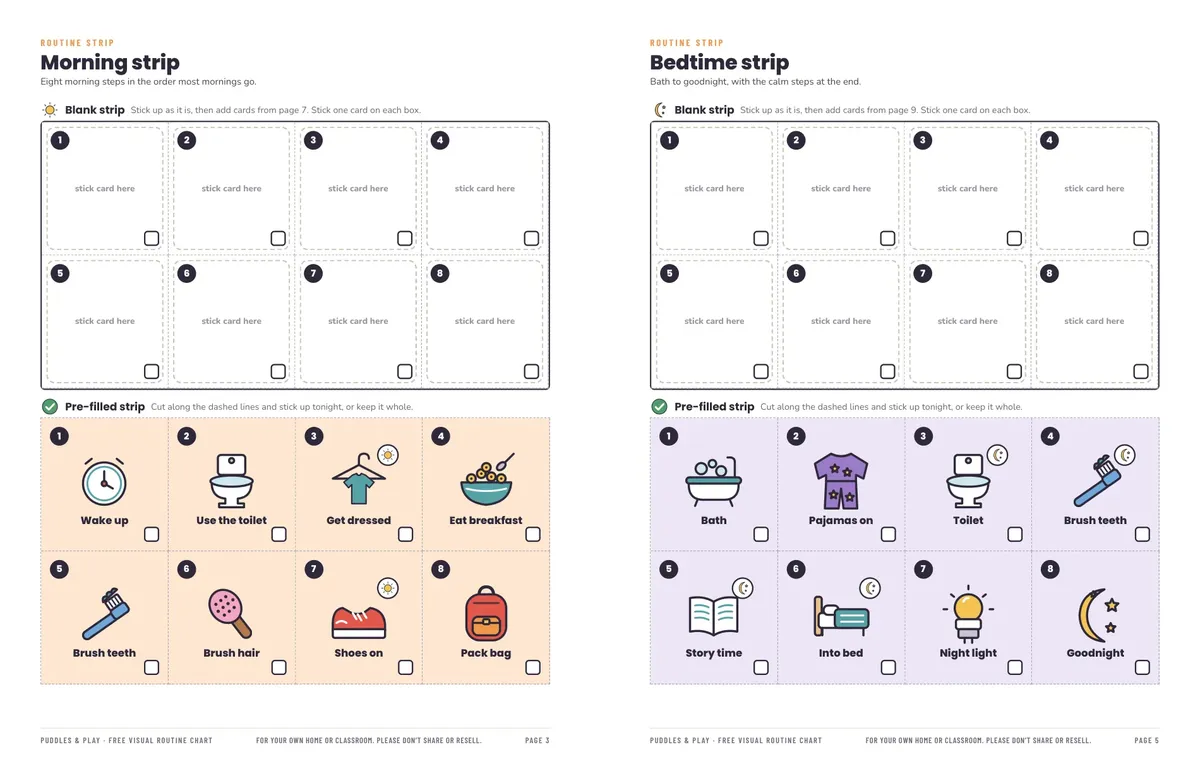
| 3 to 5 | Morning, after-school and bedtime strips, each blank and pre-filled | Eight steps with a tick box under each |
| 6 | Start with 3 steps | Three 3-step starter rows for the first week |
| 7 to 9 | 48 picture cards, 16 for each strip, plus 4 blanks per page | Filling the blank strips with your own order |
| 10 | More from Puddles and Play | What the paid kit adds |
Which strip first: morning, after school or bedtime
Pick the one part of the day that goes worst and start there. Printing all three at once is how a fridge ends up with a wall of paper nobody reads. The three strips are built for different problems.
1The morning strip: out the door without the fifth reminder
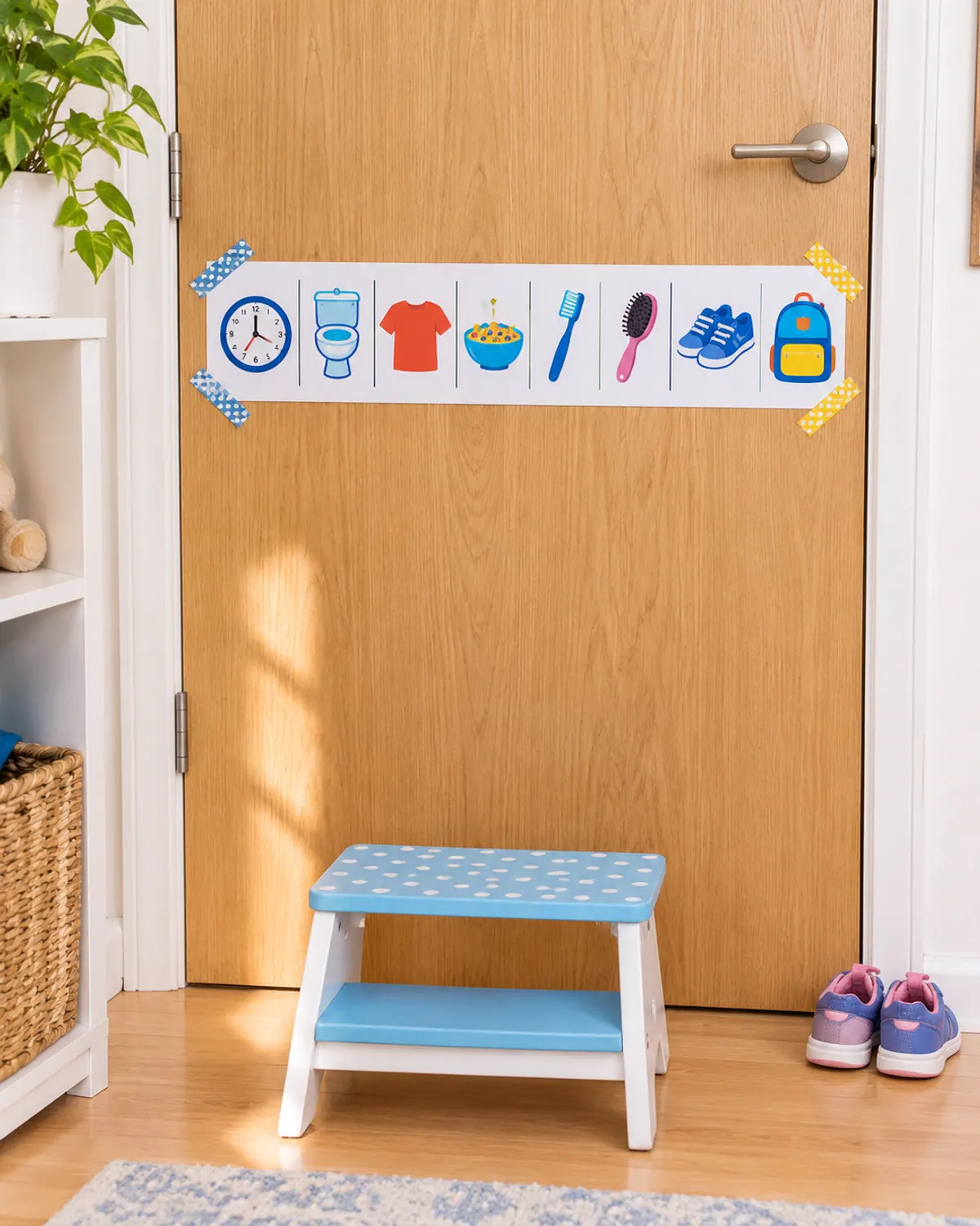
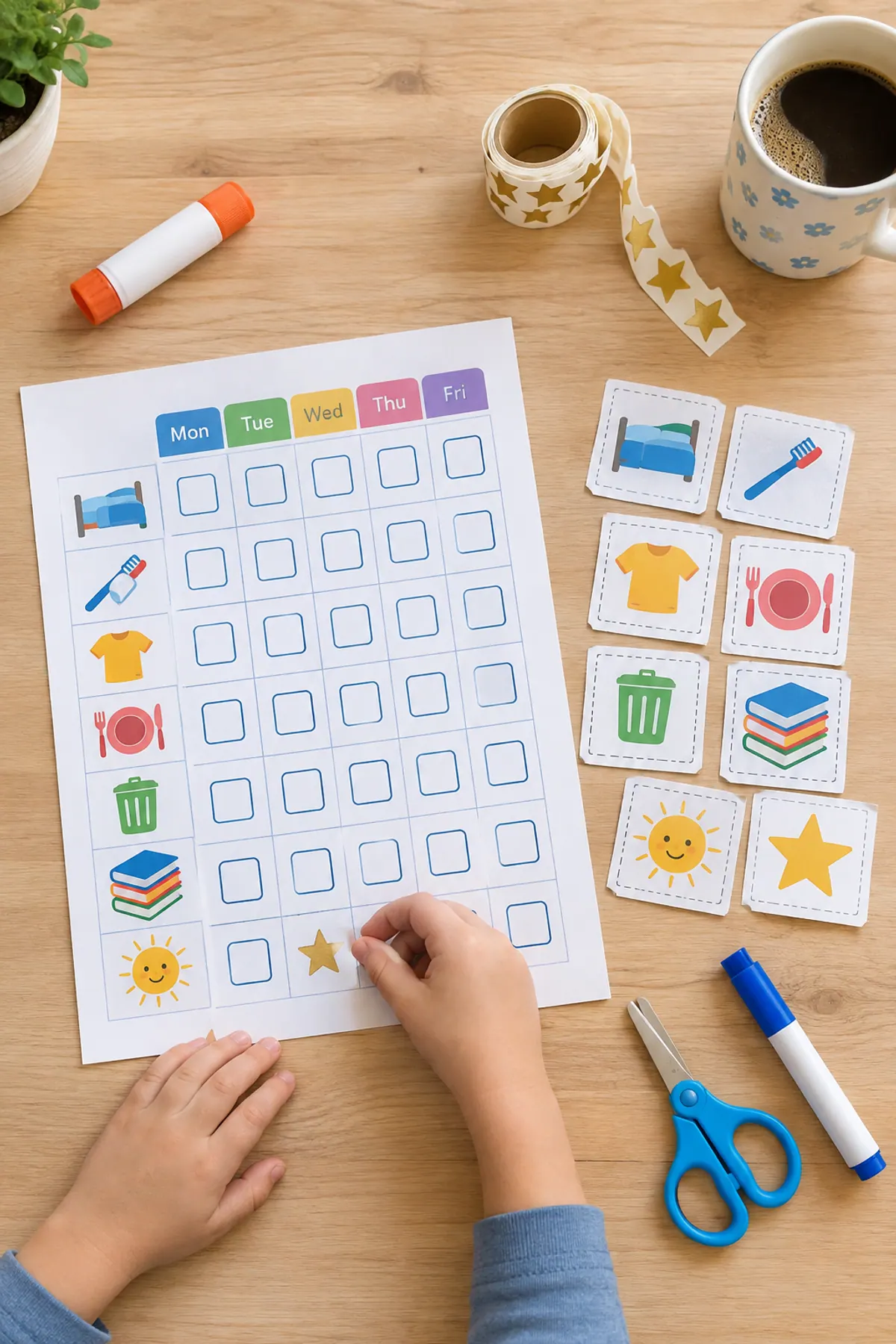
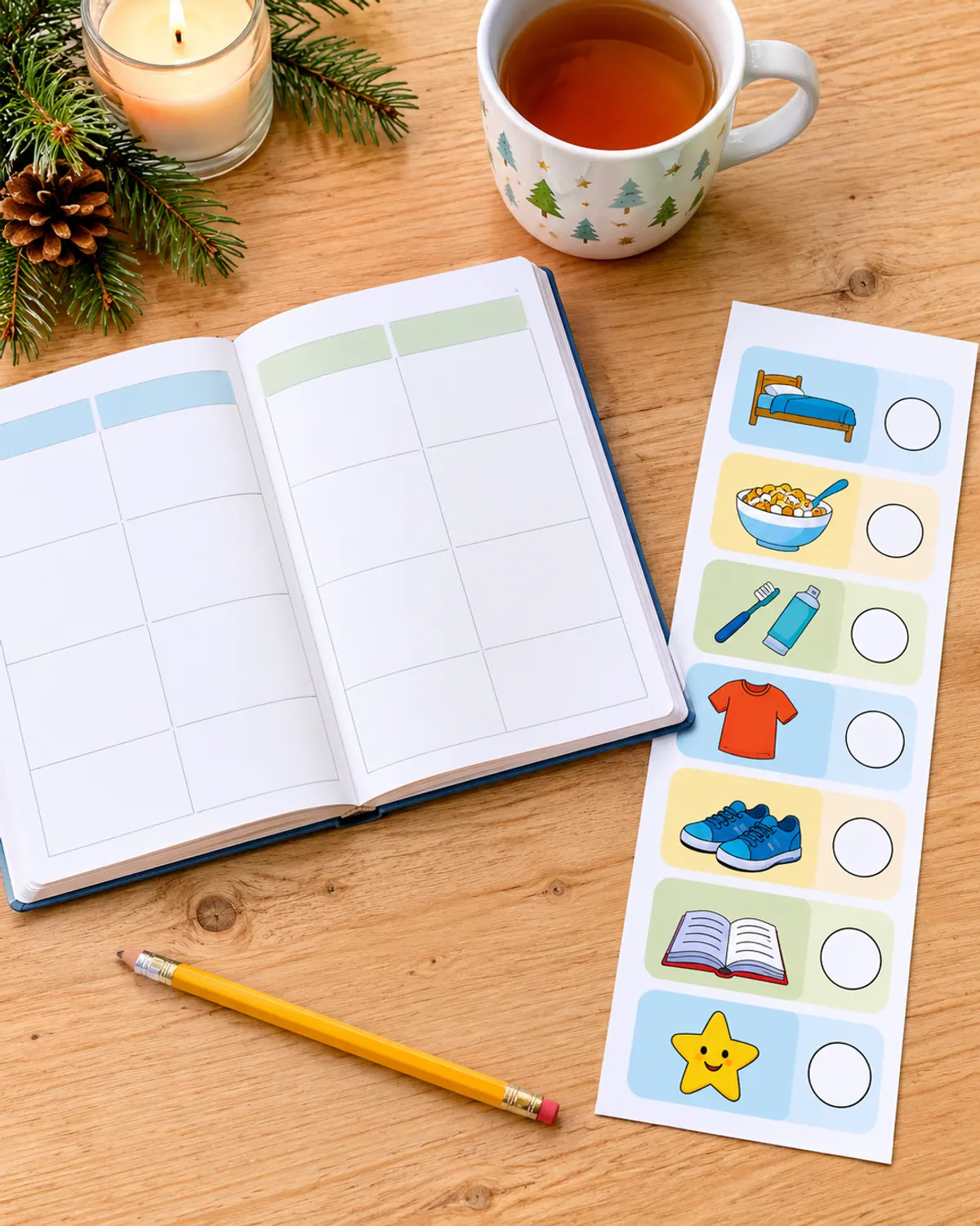
The morning strip has eight steps in the order most mornings go: wake up, use the toilet, get dressed, eat breakfast, brush teeth, brush hair, shoes on, pack bag. Hang it on the bedroom door or the fridge at your child's eye height. When your child stops halfway, say "check your strip" and point, instead of listing the next step.
Ages: 3 to 8
Prep: 5 minutes to print and cut
Mess: low, paper and tape
Supplies: pages 3 and 7, safety scissors, tape or velcro dots
Safety: a grown-up cuts for ages 3 to 4 and stays nearby while older children use scissors. Keep cut pieces away from children under 3.
Holds a paper strip on a door or wall and peels off without taking paint with it.
2The after-school strip: the hour between the front door and dinner
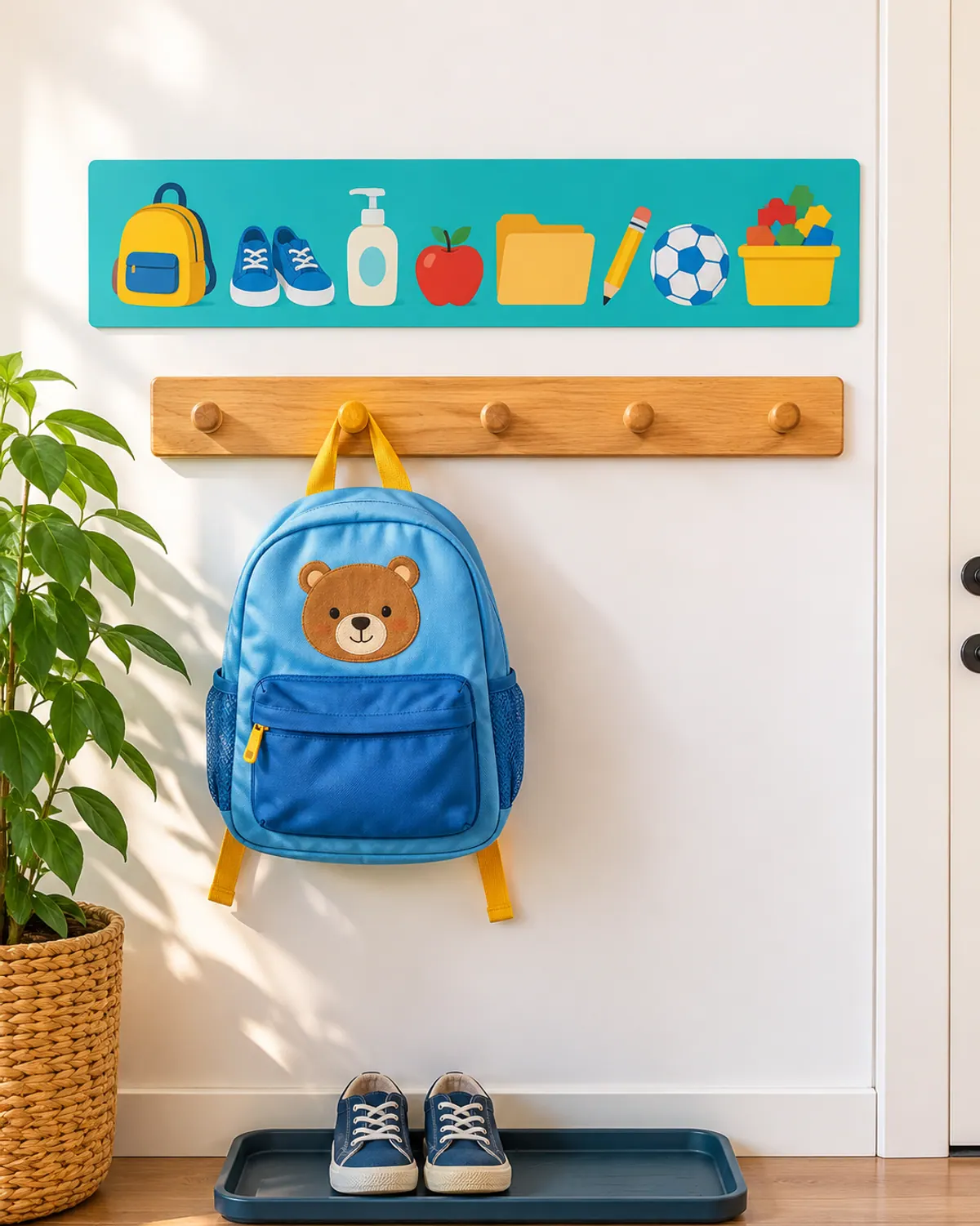
After school is where bags land on the floor and snacks happen before shoes are put away. The after-school strip runs from the front door to dinner: hang up the bag, shoes away, wash hands, snack, show the folder, homework, play outside, tidy toys. It has room for homework and for play, so the strip feels like a plan and not a list of demands. Put it by the hooks, where the bag goes.
Ages: 4 to 8
Prep: 5 minutes
Mess: low
Supplies: pages 4 and 8, tape or a hook near the door
Safety: stay with your child for snacks, and cut food for ages 3 to 4 into small pieces. Cut paper pieces stay away from children under 3.
3The bedtime strip: bath to goodnight, calm steps last
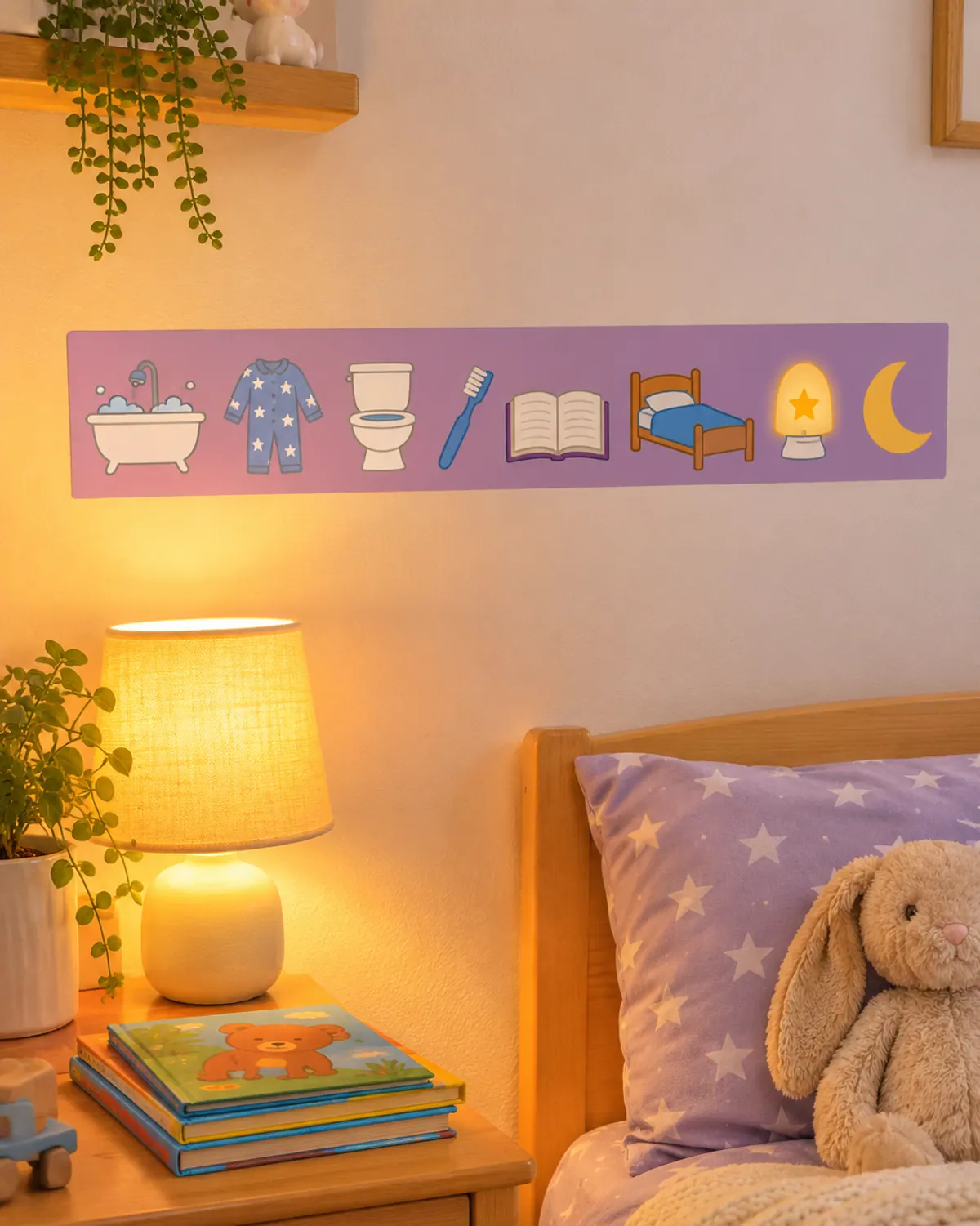
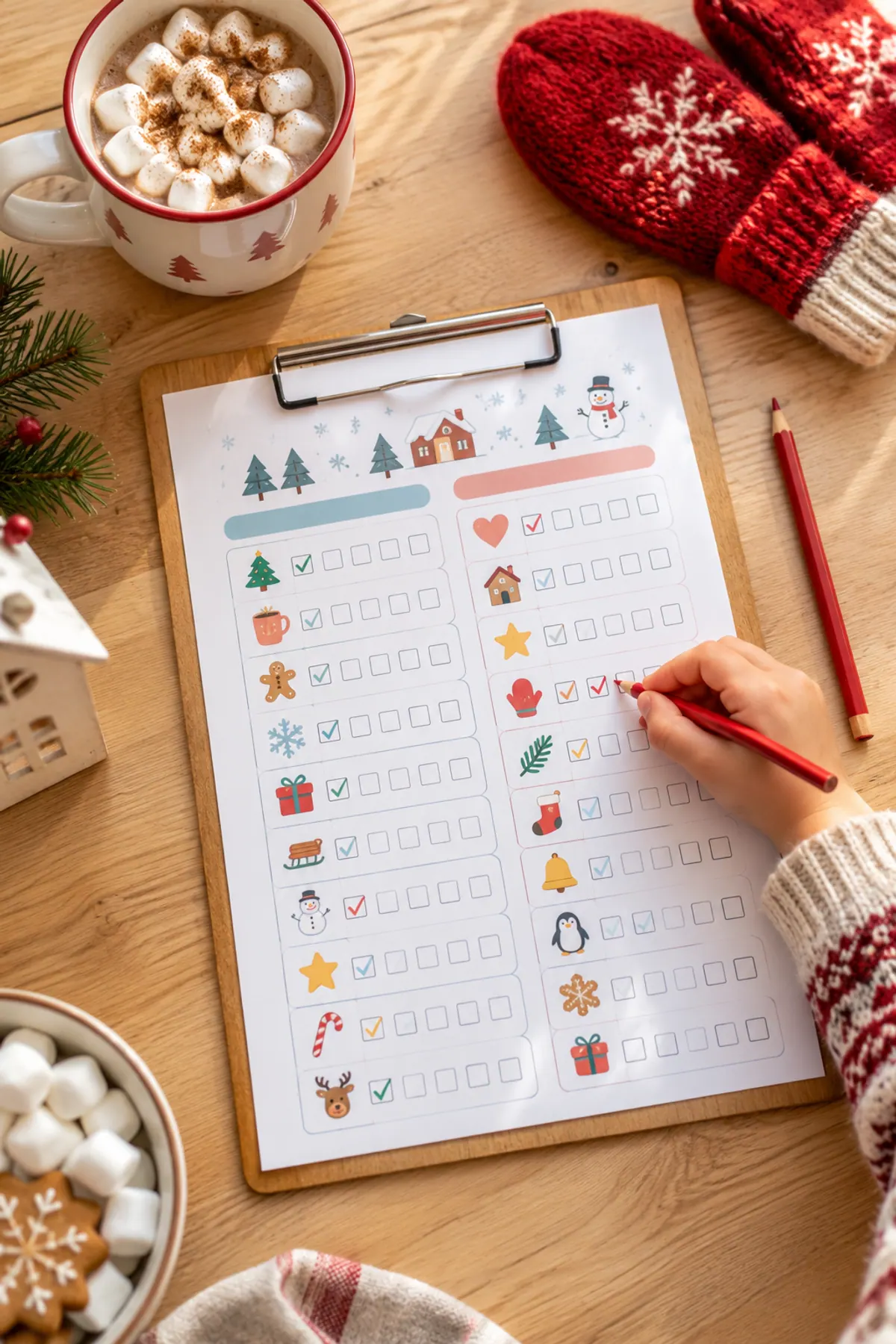
The bedtime strip goes from bath to goodnight with the calm steps at the end: bath, pajamas, toilet, brush teeth, story, into bed, night light, goodnight. Put it at your child's eye height by the bed, and let your child tick each box with a crayon as you go. Ticking is the child's part, and it gives them something to do besides stall.
Ages: 3 to 8
Prep: 5 minutes
Mess: low
Supplies: pages 5 and 9, a crayon, tape
Safety: a grown-up stays for bath time at every age. Keep crayons with a grown-up for children under 3.
How to set up a visual routine chart in one evening
-
Step 1:
-
Step 2:
-
Step 3:
-
Step 4:
-
Step 5:
4Cut and stick the cards for a strip that is yours
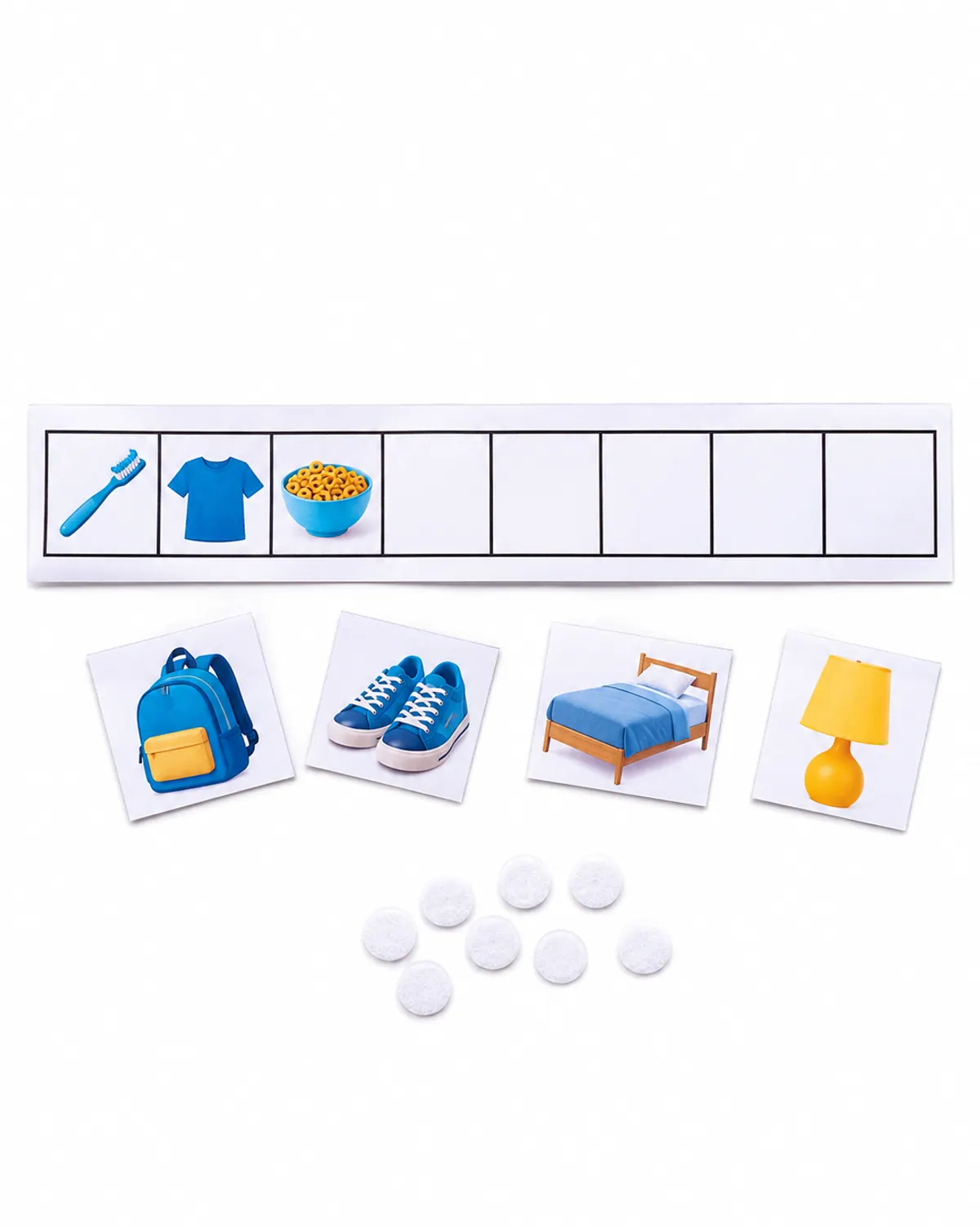
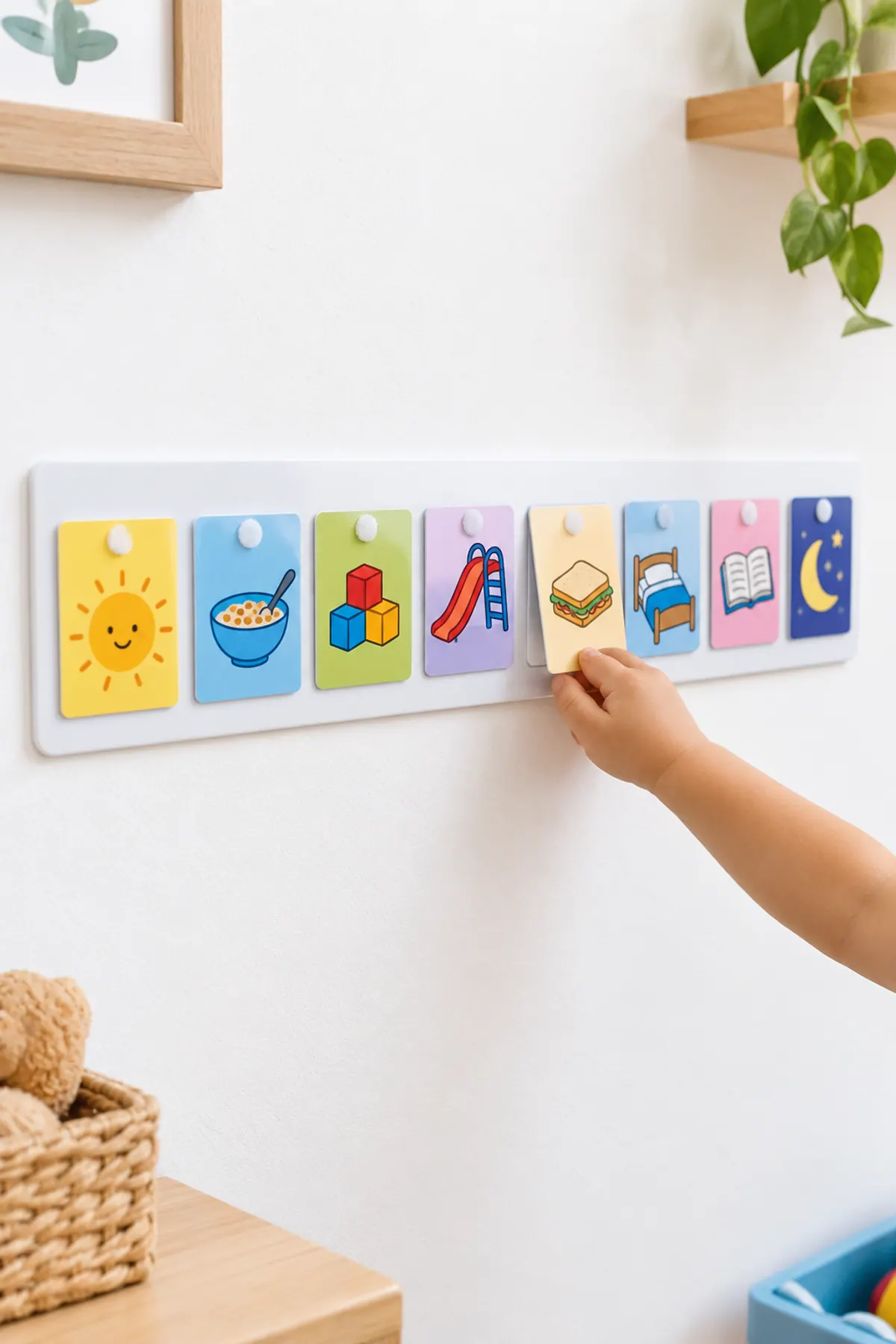
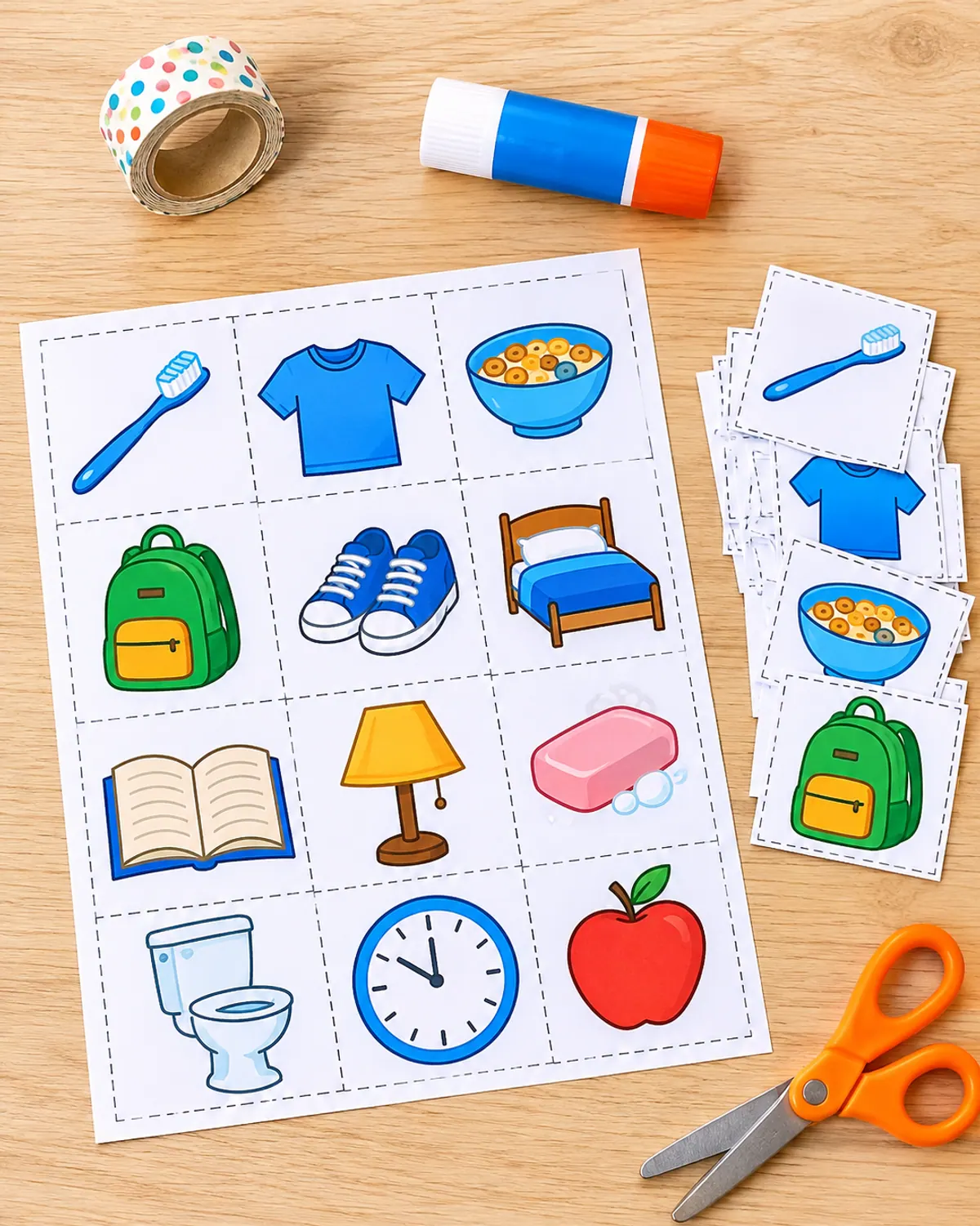
The blank strips are for families whose order is different. Maybe shoes come before breakfast, or your child has a pet to feed. Pick the cards you need from the card pages (page 7 for morning, 8 for after school, 9 for bedtime) and stick one on each box. Each card page also has 4 blank cards, so you can draw a step that only your house has, like feeding the cat.
Ages: 3 to 8
Prep: 10 minutes to cut and place
Mess: low
Supplies: card pages, safety scissors, velcro dots or a glue stick
Safety: small velcro dots and cut paper are a choking hazard for children under 3, so keep them out of reach and use a pre-filled strip taped whole.
Lets cards move from the box to a done pile, or swap places when the routine changes.
A visual routine chart for kids who can't read yet
A list of words means nothing to a 4 year old, so a written chart brings you back to saying every step out loud. A picture can be followed on its own. That is the whole point of a visual routine chart: the steps live on the wall and not in your voice.
Each card has a plain drawing and a short word under it. A child who cannot read follows the picture. A child who is learning to read sees the word beside it and starts to match them without being drilled.
| Age | How to use it | How many steps |
|---|---|---|
| 3 to 4 | A grown-up cuts and sticks. Child touches each picture and ticks the box with you. | 3 steps, then add one when it works |
| 5 to 6 | Child places cards on the blank strip and cuts with safety scissors. | 4 to 6 steps |
| 7 to 8 | Child chooses the cards, moves them and ticks alone, with a quick check from you. | Up to 8 steps, the full strip |
Start with 3 steps, not 8
Page 6 of the PDF has three starter rows, one for each part of the day, with only 3 steps each and an empty fourth slot. Use one row for the first week. When your child does the 3 steps without a reminder, add the next card. A short strip that works beats a long strip that gets ignored.
A 14-day visual routine reset for January
January is a natural time to reset a routine, because winter break has loosened every habit and school starts again. January 1, 2027 is a Friday, so a 14-day reset runs from Friday, January 1 to Thursday, January 14. Many schools restart in the first week of January, so check your own school's date. Start the strips before then and you can adjust them while the days are still easy.
14-day reset with the free strips
Make the strips last: laminate, dry-erase and low ink
5Slide it into a dry-erase pocket
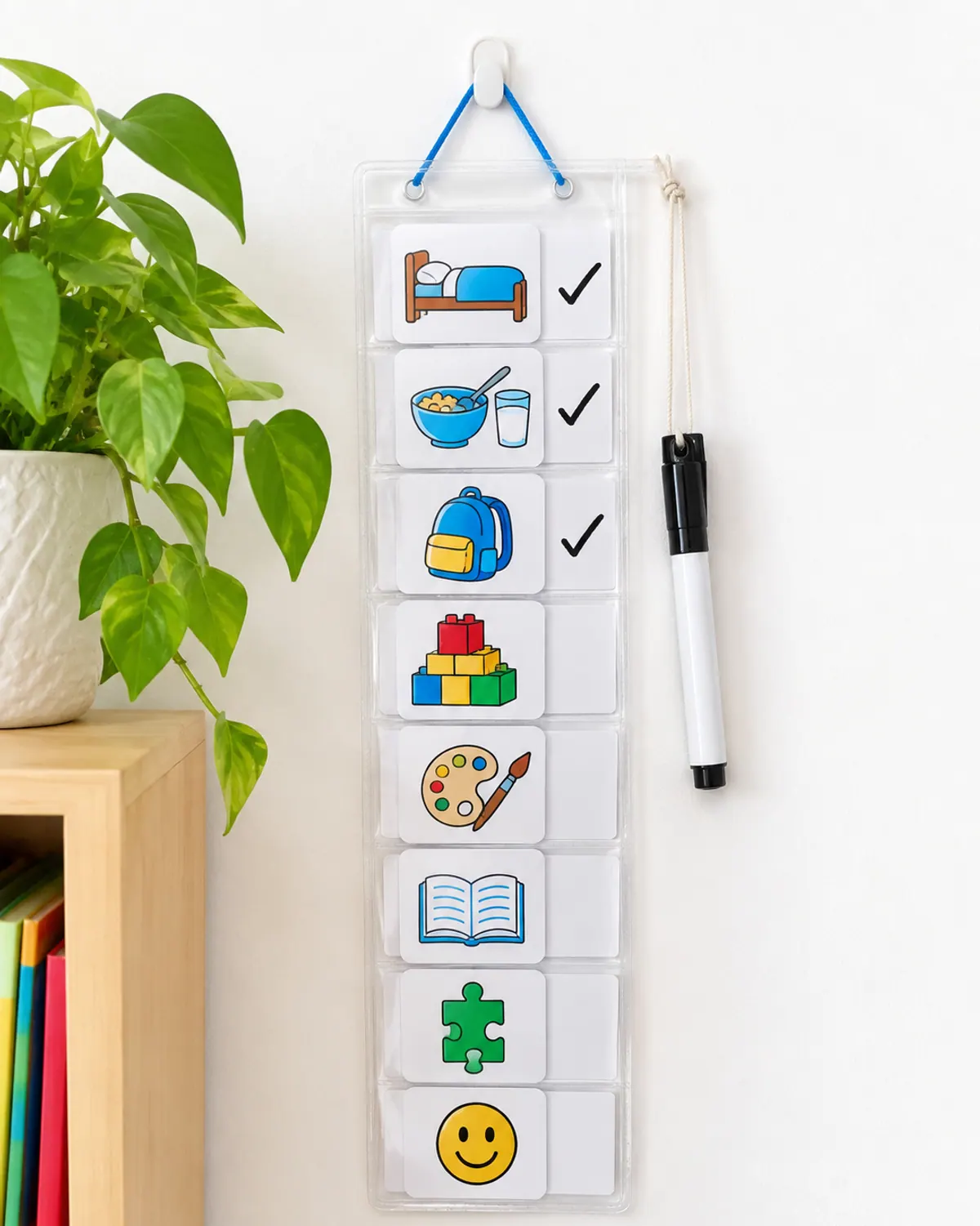
Print once, slip the strip into a clear dry-erase pocket and tick the boxes with a marker. Wipe it clean each morning or each Sunday night, and one print lasts for months. A laminating pouch does the same job with cards that stay put.
Ages: 3 to 8
Prep: 5 minutes
Mess: low
Supplies: a dry-erase pocket or laminating pouch, a thin dry-erase marker
Safety: dry-erase markers are for a child who no longer mouths things, and the cap stays with a grown-up for children under 3.
Reuse one print for weeks, and wipe the ticks off each day.
6Print it in black and white
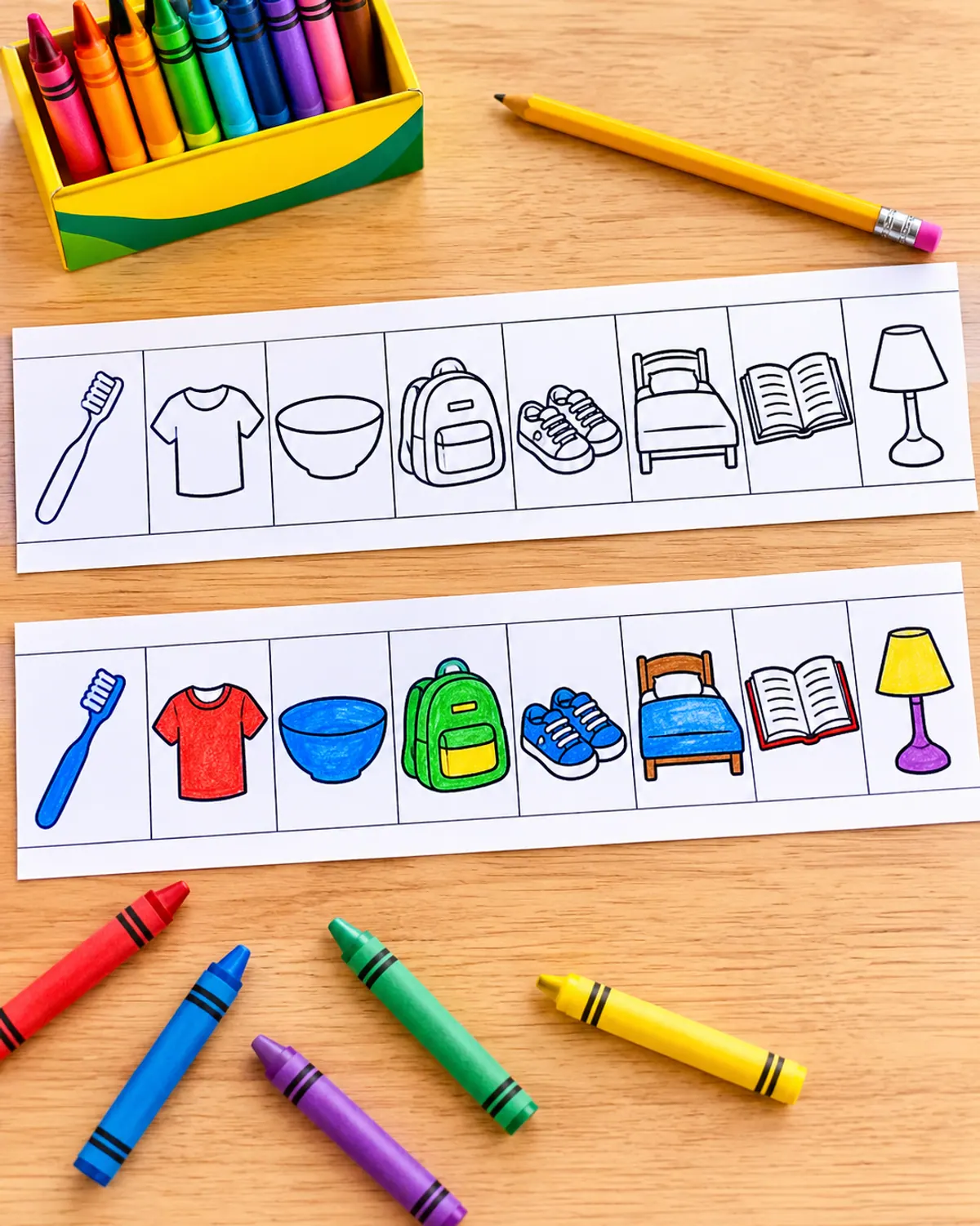
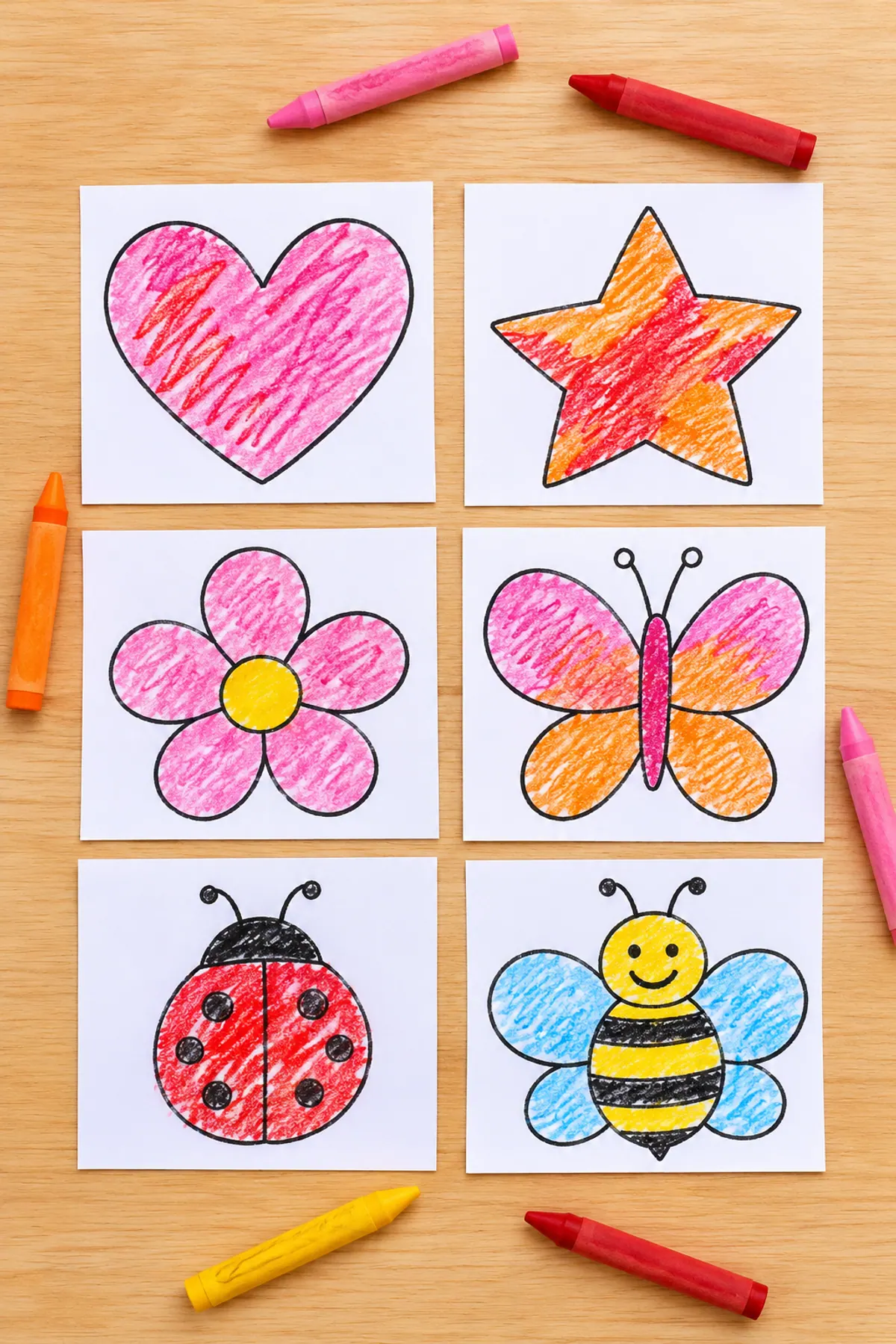
All three strips and the cards work in black and white, with each picture shown as an outline you can color. Choose Grayscale or Low ink in your printer settings, or color the cards with your child. Coloring them is a good rainy-day job and gets your child to care about the chart.
Ages: 3 to 8
Prep: 5 minutes
Mess: low, crayons
Supplies: a printer on grayscale, crayons or colored pencils
Safety: crayons and pencils stay with a grown-up for children under 3.
When a visual routine chart does not work
Every child and every house is different, and a chart will not stop every argument. Change one thing at a time for a few days before you try the next. If the strip is ignored, cut it to 3 cards and move it to where the step happens. If your child ticks every box without doing the step, do the steps together for a few days. A new child, a new school year or a new baby can all knock a routine over, and that is normal.
When the free strips are not enough
The free set covers three strips and 48 cards. If you also need the getting-dressed part of the day, chores, or cards big enough for a child to see from across the room, the Visual Routine and Chore Chart Kit adds them for $7: 80 picture cards, a getting-dressed strip, 12 big cards, First then boards, three chore charts by age (3 to 4, 5 to 6 and 7 to 8), a weekly star tracker, a 30 day sticker path and a reward menu.
If you only want a chore chart to start, the free printable chore chart for kids is a separate free download, and the toddler schedule at home post shows how to build a picture schedule for the youngest. For a short list of goals to pair with the strips, see New Year resolutions for kids.
Supplies for visual routine strips
- Most used
Safety scissors for kids, round tip
Typically $4 to $10
For cutting the cards on the dashed lines.
Check price on Amazon for Safety scissors for kids, round tip -
Self-adhesive hook-and-loop dots, small, 200 pack
Typically $5 to $10
Stick cards to the strip and move them.
Check price on Amazon for Self-adhesive hook-and-loop dots, small, 200 pack -
Dry-erase pockets, letter size, 10 pack
Typically $10 to $16
Tick the boxes and wipe them clean.
Check price on Amazon for Dry-erase pockets, letter size, 10 pack -
Thin dry-erase markers, assorted
Typically $6 to $12
For ticking the boxes in a dry-erase pocket.
Check price on Amazon for Thin dry-erase markers, assorted -
Laminating pouches, letter size
Typically $8 to $15
Cards that survive daily handling. Needs a laminator.
Check price on Amazon for Laminating pouches, letter size -
Washi tape or low-tack painter's tape
Typically $5 to $12
Holds a strip on a door or wall.
Check price on Amazon for Washi tape or low-tack painter's tape
Frequently asked questions
Is the visual routine chart really free?
Yes. The 10-page PDF is a free download on this page and teachers may print copies for their own class. The last page shows the paid Visual Routine and Chore Chart Kit, but the three strips and 48 cards are complete without it.
What ages is a visual routine chart for?
The strips suit ages 3 to 8. Ages 3 to 4 need a grown-up to cut and stick and do best with 3 steps. Ages 5 to 6 can place cards and cut with safety scissors. Ages 7 to 8 can choose the cards and tick alone.
How do I make a visual routine chart for a child who can't read?
Use a picture for every step and keep the strip short. Each card in the free PDF is a plain drawing with a word underneath, so a child follows the picture while the word sits beside it. Start with 3 steps, put the strip at eye height where the step happens and point at it instead of repeating.
Do I have to cut out the cards?
No. The pre-filled strip works as it is, taped to the fridge or a door. Cutting and sticking is for the blank strip, when you want your own order.
Will a routine chart stop the morning arguments?
We cannot promise that, and every child and house is different. The strip makes the steps visible so you point and do not repeat. The page on when it does not work lists what to change first.
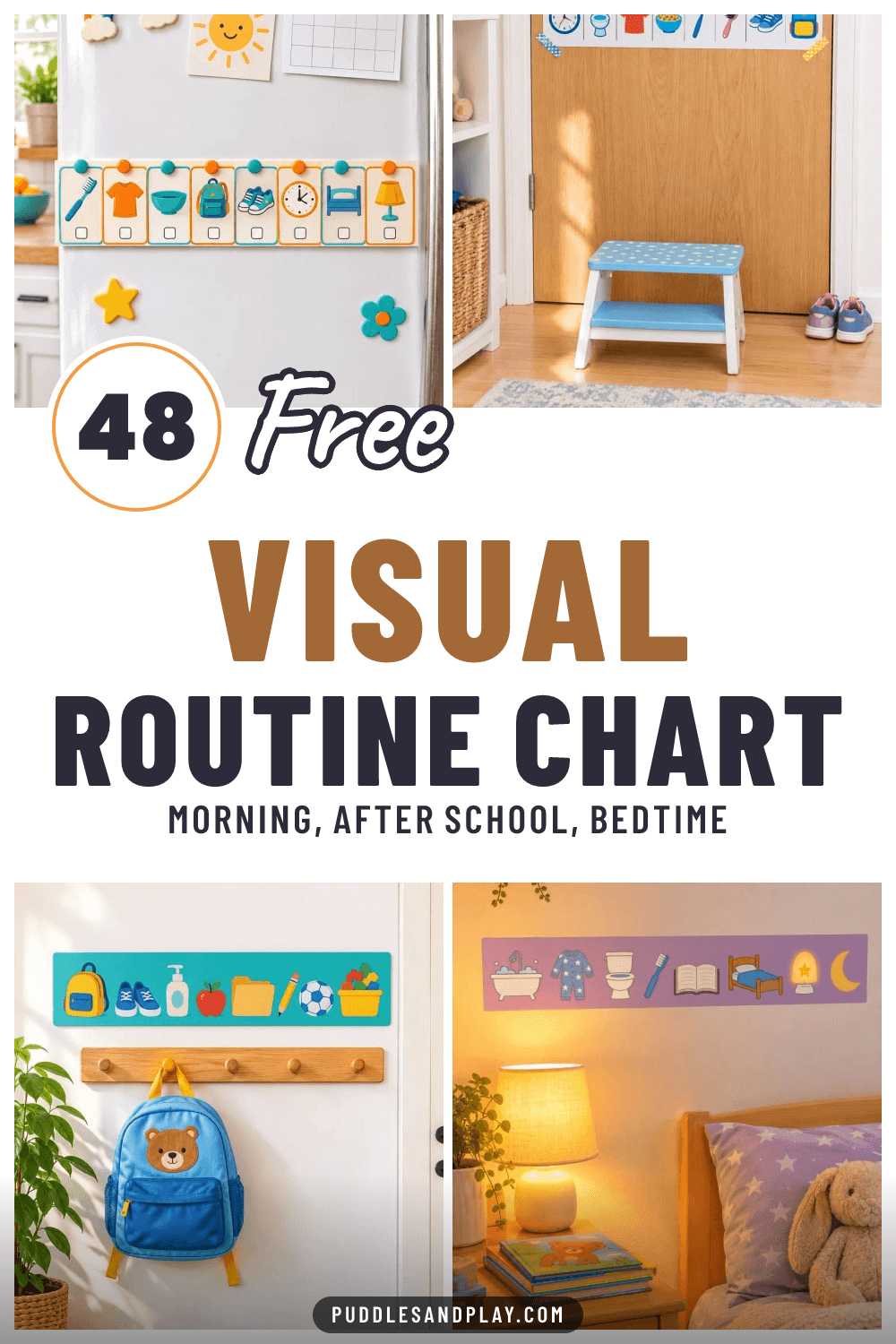
Save it for later
Pin this to your Printables board so it's there when you need it.
Save to Pinterest