This post contains affiliate links. As an Amazon Associate we earn from qualifying purchases, at no extra cost to you. Read our disclosure.
Safety first: Always supervise little ones, and skip small parts for kids who still put things in their mouths. Please read our play safety notes before you start.
Key takeaways
- Match the filler to the youngest child: potato flakes for ages 1 to 2, instant snow, rice and beans for 3 and up.
- Instant snow is not taste safe and should never go down the drain.
- Use the toilet paper tube rule: anything that fits through is a choking hazard under 3.
- Keep bins short and supervised, and rotate two or three bins with lids all winter.
In this post29 sections
- Fake Snow Showdown: Which Winter Filler Should You Use?
- Taste Safe Winter Sensory Bins for Toddlers (Ages 1 to 2)
- 1. Potato flake snow bin
- 2. Mitten and hat texture bin
- 3. Muffin tin mini ice melts
- Winter Sensory Bin Ideas for Preschool (Ages 3 to 5)
- 4. Instant snow arctic dig
- 5. Polar bear magnetic fishing in blue rice
- 6. White bean and pinecone forest
- 7. Epsom salt sparkle snow
- Winter Sensory Bins for Kindergarten (Letters and Counting)
- 8. Snowball letter hunt
- 9. Cotton ball ten frame
- 10. Snowflake sight word dig
- Arctic Small World Bins
- 11. Arctic and forest animal sort
- 12. Penguin ice slide
- 13. Iceberg ocean bin
- Ice Science Winter Sensory Bins
- 14. Salt and color ice melt tunnels
- 15. Colored ice cube painting
- Cheap Winter Sensory Bins (Under $5)
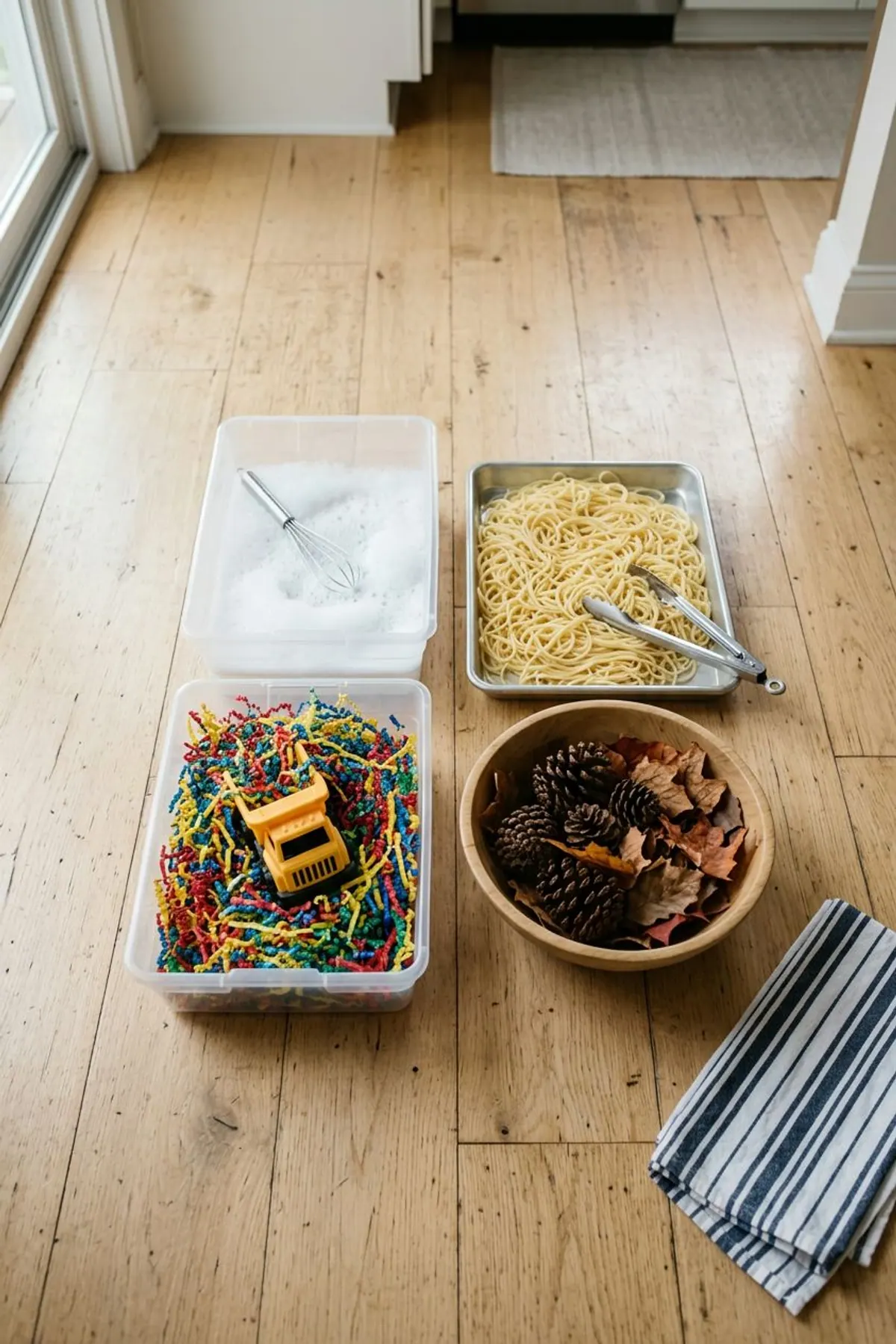
- 16. Shredded paper blizzard bin
- 17. White rice scoop and pour station
- 18. Baking soda snow fizz
- 19. Snowflake play dough tray
- Setup, Cleanup and Supervision
- Winter Sensory Bin Supplies
- FAQ
Fake Snow Showdown: Which Winter Filler Should You Use?
Most winter sensory bins start with something white and snowy. The filler you pick decides who can play, how big the mess is and how long the bin lasts, so start here. The table compares the common winter fillers side by side.
| Filler | Feels like | Taste safe? | Mess | Lasts | Rough cost | Best for |
|---|---|---|---|---|---|---|
| Instant snow powder | Cold, fluffy, wet snow | No | Medium | Several days if kept covered; add water to refresh | $3 to $8 a pack | Ages 3 and up who no longer mouth |
| Potato flakes | Soft, crumbly snow | Yes (plain flakes) | Medium to high | 1 to 2 days once wet | $2 to $4 a box | Ages 1 to 2 |
| Cotton balls or batting | Soft, dry, fluffy drifts | No | Low | Weeks | $2 to $5 | Ages 3 and up; ages 2 to 3 with close supervision |
| Plain white rice | Pourable, dry, scratchy | No (raw) | Medium (it scatters) | Months, stored dry | $2 to $4 a bag | Ages 3 and up; ages 2 to 3 with close supervision |
| Real snow | Real cold and wet | Not for eating | High (it melts) | About 20 to 40 minutes inside | Free | All ages, short sessions |
| Cloud dough | Moldable, silky powder | Not for under 3s | High | Weeks, stored dry | $2 to $4 | Ages 3 and up |
| Shaving cream | Foamy and cool | No | High | One session | $1 to $3 | Ages 3 and up who no longer mouth |
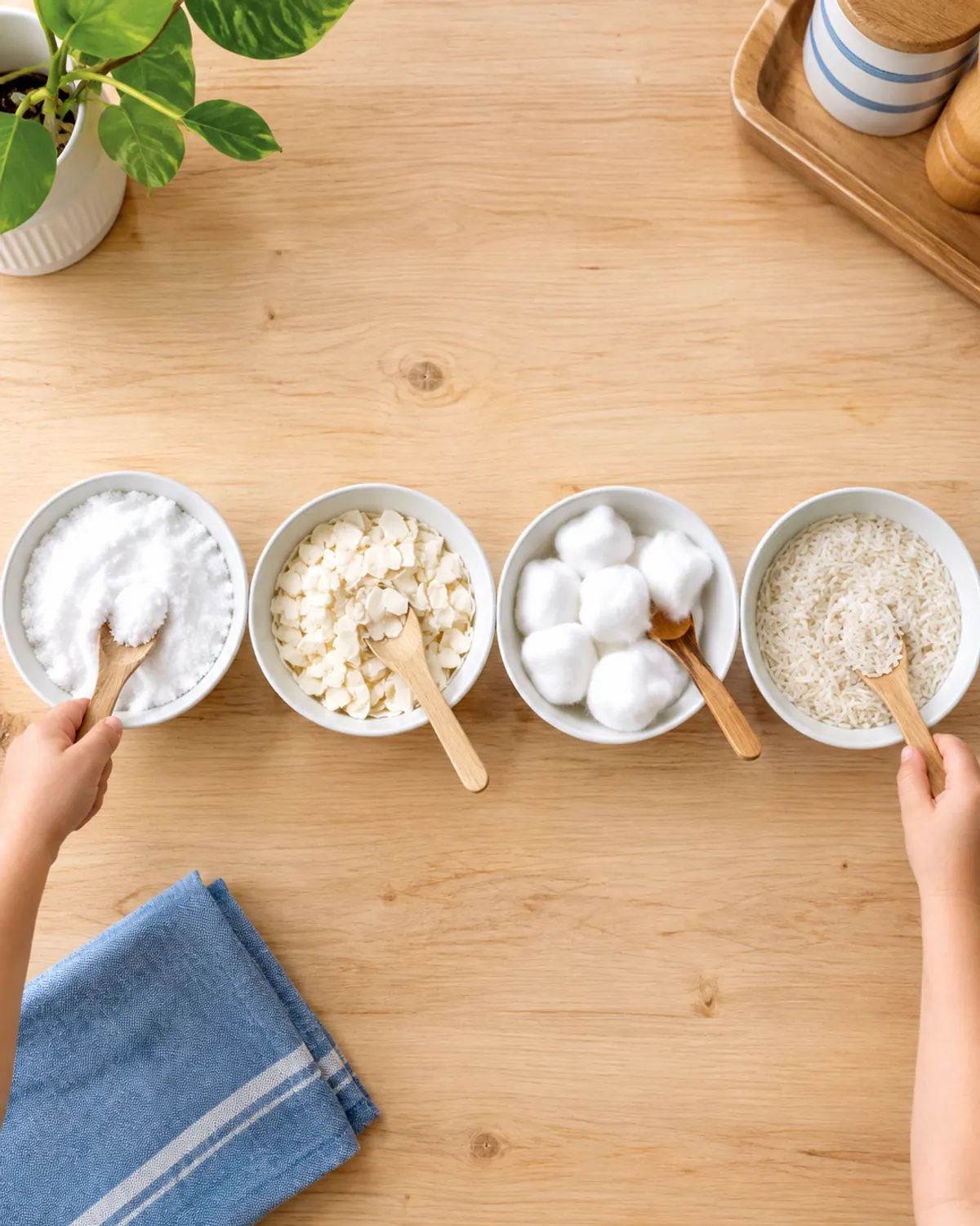
Cloud dough snow, shaving cream snow, oat snow and a real snow bin are all covered step by step, with safety notes, in our Christmas sensory bin ideas. The 19 bins below use other fillers and themes, so you can run a new bin every week from December to February without repeating.
Taste Safe Winter Sensory Bins for Toddlers (Ages 1 to 2)
Toddlers explore with their mouths, so these winter sensory bins for toddlers use fillers that are food or big, soft items. Taste safe still means supervised: stay within arm's reach, sit the toddler on the floor or in a high chair, and keep sessions to 10 or 15 minutes.
1Potato flake snow bin
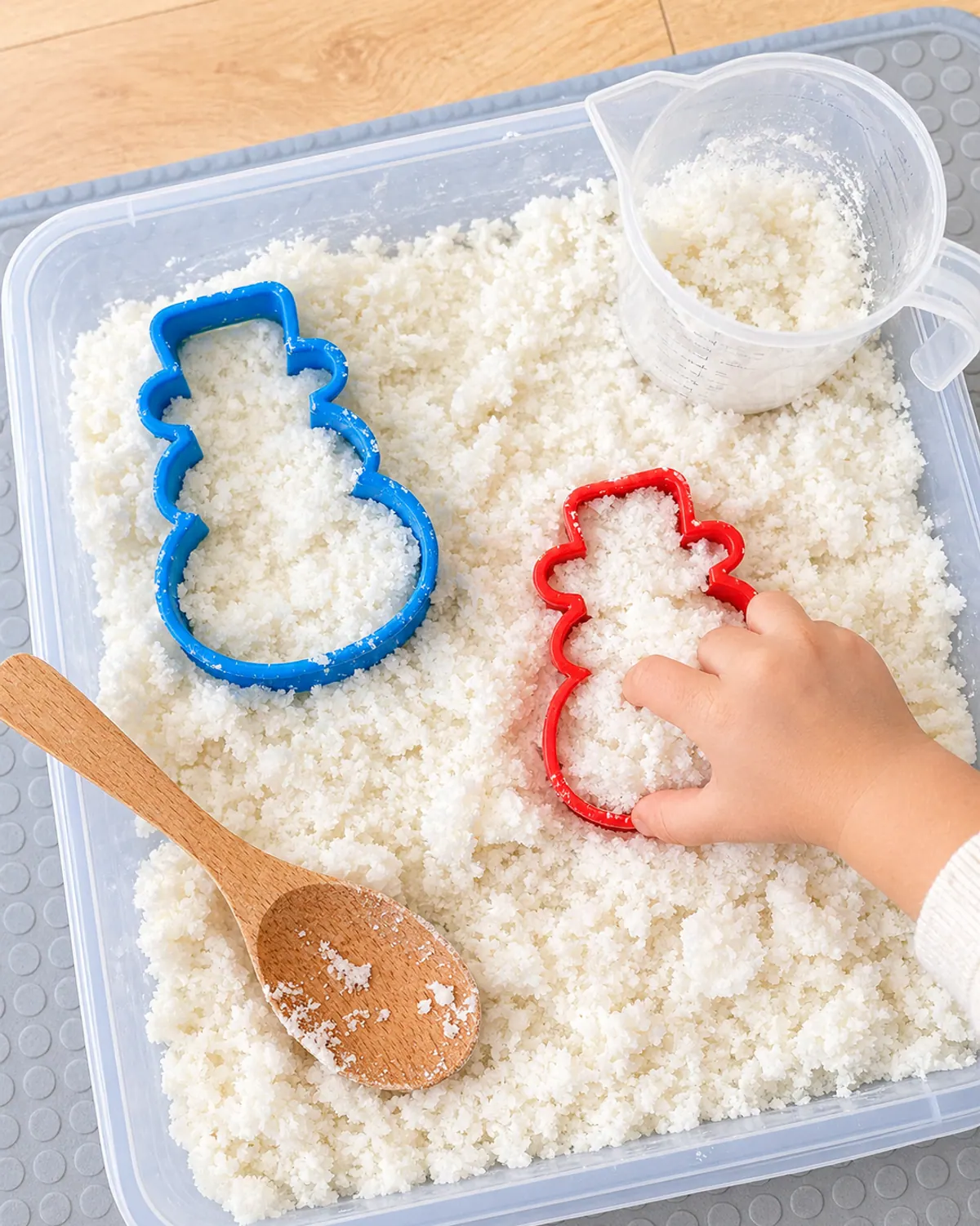
Pour plain instant potato flakes into a bin and add a splash of water a little at a time until it feels like crumbly, packable snow. Add snowman shaped cookie cutters, a few big spoons and a cup for filling and dumping. Toddlers can squish it, press shapes and scoop it from side to side.
Ages: 1 to 3.
Prep: 5 minutes.
Mess: medium to high (it sticks to clothes; sweep it up dry).
Supplies: a box of plain instant potato flakes, water, cookie cutters, spoons.
Safety: use plain flakes with no added flavor packets, and watch for any food allergies. It is food, but a toddler should not eat a lot of it. Stay within arm's reach.
- Toss it after a day or two once it is wet, since it can spoil.
2Mitten and hat texture bin
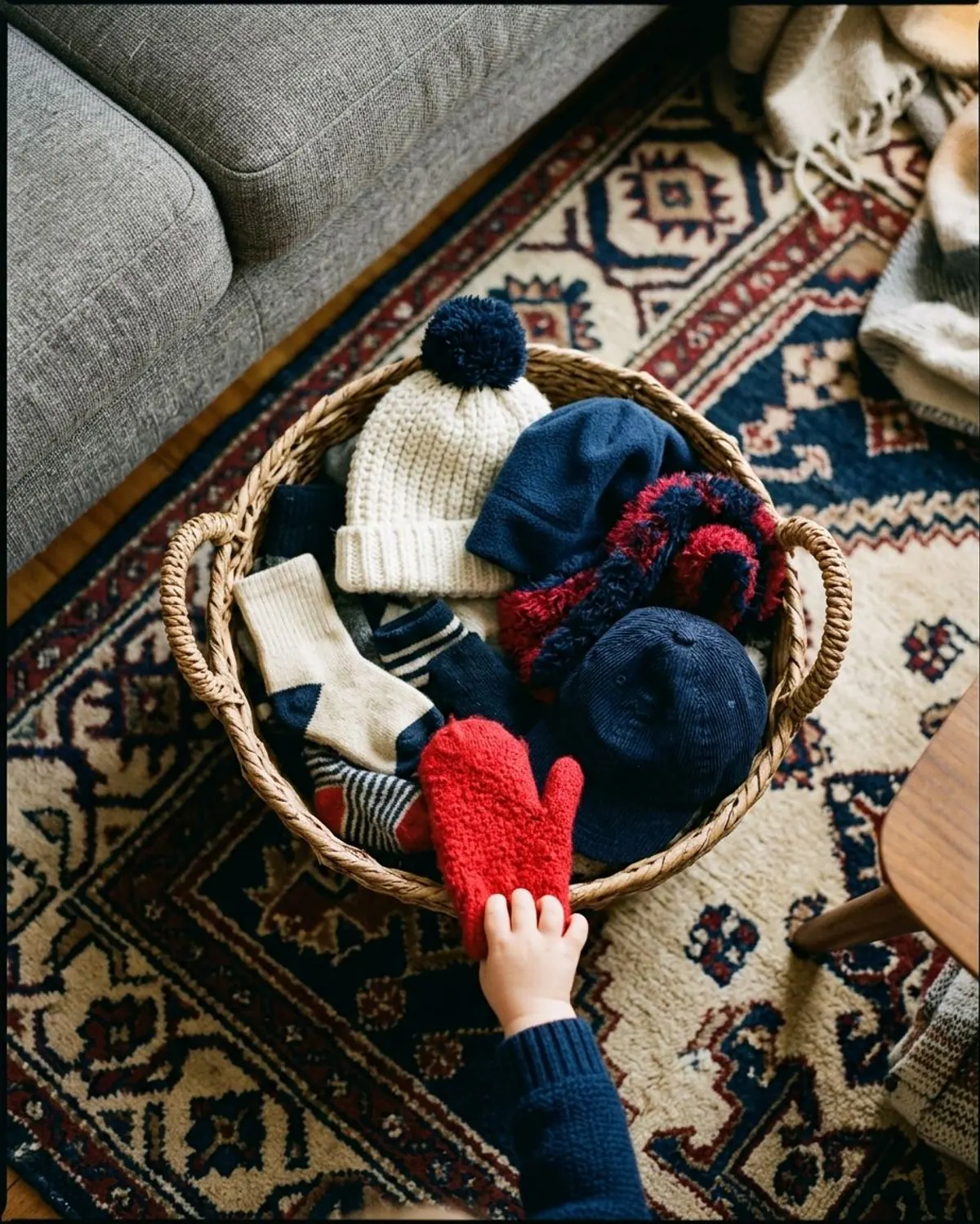
Fill a low basket with soft winter clothes: knit mittens, a fleece hat, a fuzzy scarf, wool socks and a corduroy hat. Toddlers pull them out, feel the textures, try them on their hands and put them back. Name each texture as they touch it: soft, bumpy, fuzzy, smooth.
Ages: 1 to 2.
Prep: 2 minutes (raid the closet).
Mess: none.
Supplies: a low basket, 6 to 10 pieces of winter clothing.
Safety: skip anything with long drawstrings, loose pom poms or buttons that could come off. Fold scarves short so they can't wrap around a neck.
- Hide a favorite board book under the clothes for a little surprise.
3Muffin tin mini ice melts
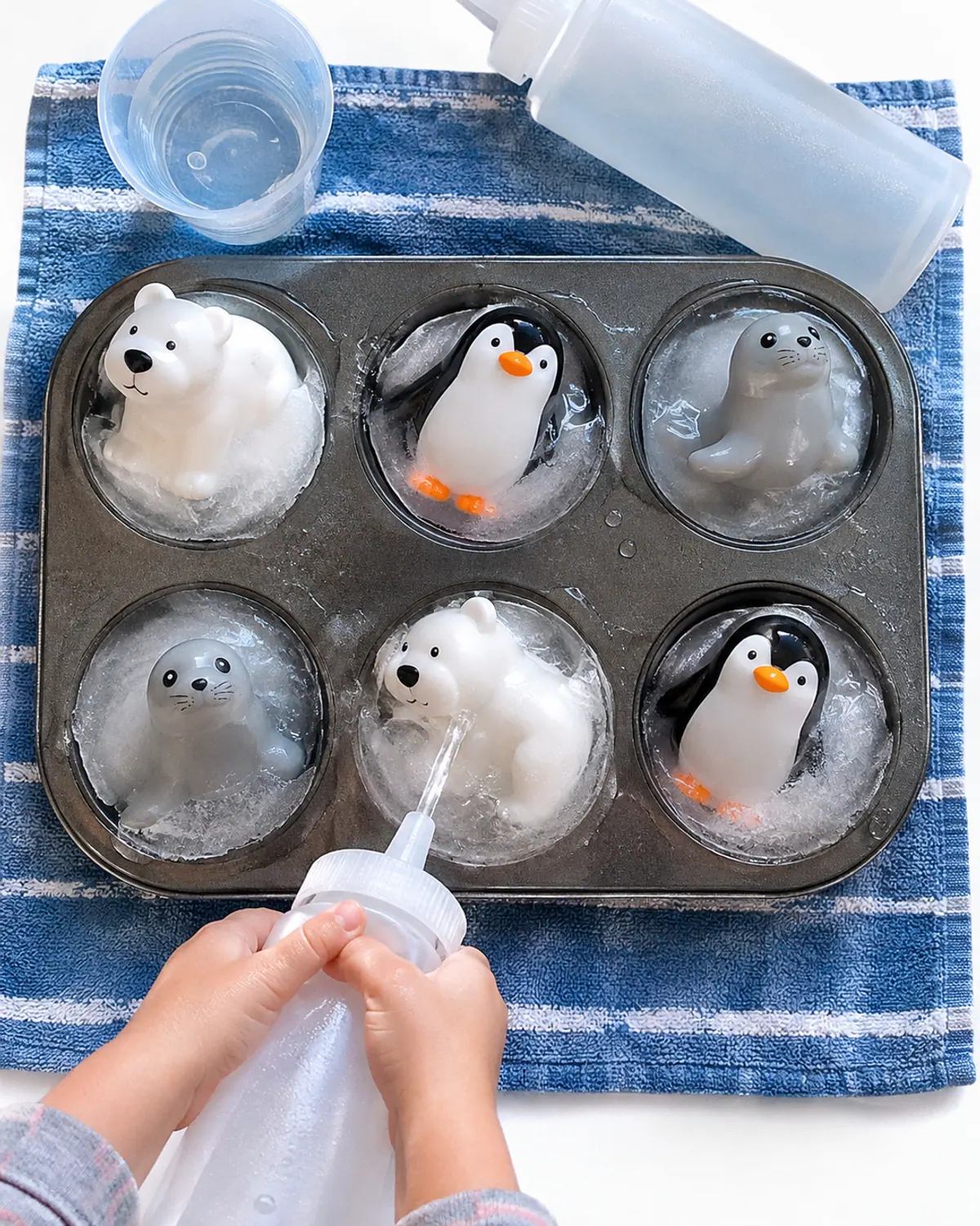
Freeze water in a jumbo muffin tin with one chunky toy animal in each cup and a drop of food coloring in a few. Pop out the ice discs into a tray and hand over a cup of warm water and a big squeeze bottle or a spoon. Small discs thaw in about 10 minutes, so toddlers see the toy come free before they lose interest.
Ages: 1 to 3 (squeeze bottle for 1s, pipettes from age 2).
Prep: 5 minutes, plus freezing overnight.
Mess: medium (water play; use a towel under the tray).
Supplies: a jumbo muffin tin, water, chunky toddler-size toy animals, warm water, a squeeze bottle or pipettes.
Safety: use toys bigger than a toilet paper tube is wide, and let the ice sit out for a minute so it isn't stuck to warm skin. Use warm, not hot, water.
- Add the warm water to a small cup, not a big jug, so the spill is small.
Winter Sensory Bin Ideas for Preschool (Ages 3 to 5)
By 3 or 4, most kids have stopped mouthing everything, which opens up the classic winter sensory bin preschool fillers: instant snow, rice, beans and salt. Check your own child first. If they still put things in their mouth, stay with the toddler section a little longer.
4Instant snow arctic dig
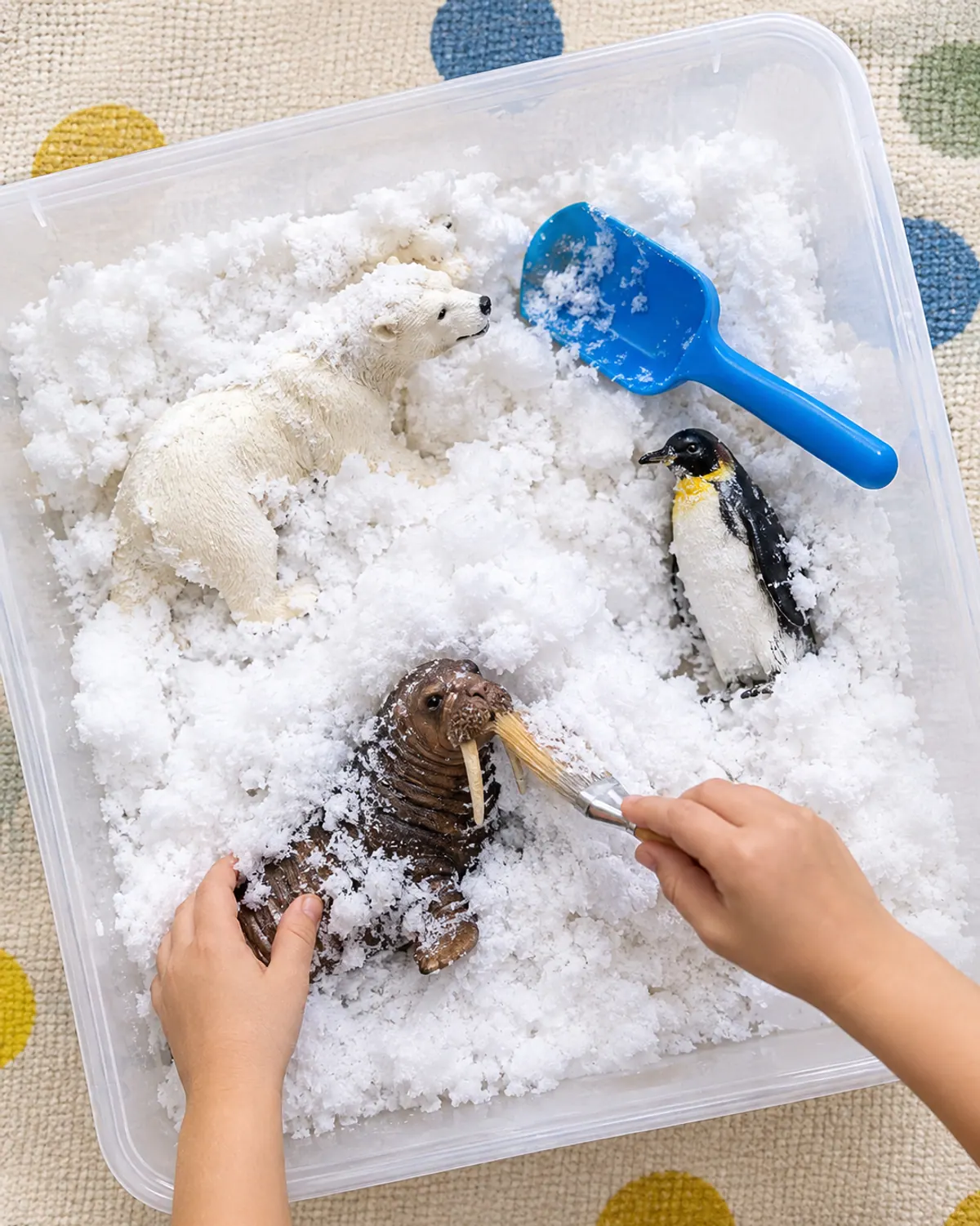
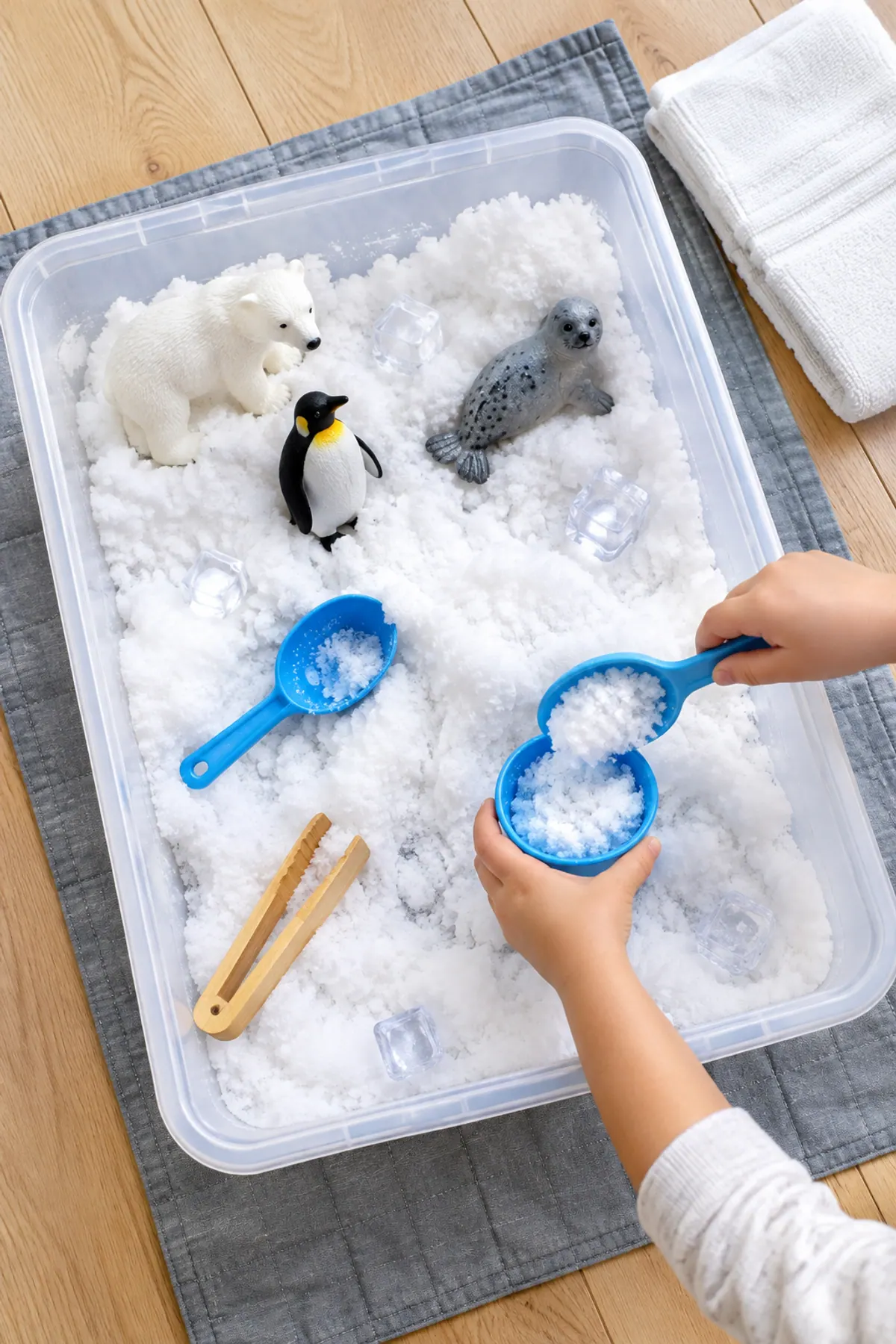
Sprinkle instant snow powder into a clear bin, add water and watch it puff up into cold, fluffy snow in seconds. Bury a polar bear, a penguin, a walrus and a seal, then hand over a scoop and a soft paintbrush. Kids dig, brush the snow off each animal and line them up. The snow stays cold and damp, so it feels close to the real thing.
Ages: 3 to 6.
Prep: 5 minutes.
Mess: medium.
Supplies: instant snow powder, water, a clear bin, arctic animal figures, a scoop, a paintbrush.
Safety: instant snow is not taste safe, so this bin is for kids who no longer mouth things. Wash hands after play, keep it away from eyes, and throw used snow in the trash, never down the sink.
- Make only half a bin at first. A little powder makes a lot of snow.
Add water and it puffs into cold, fluffy snow you can reuse for days.
5Polar bear magnetic fishing in blue rice
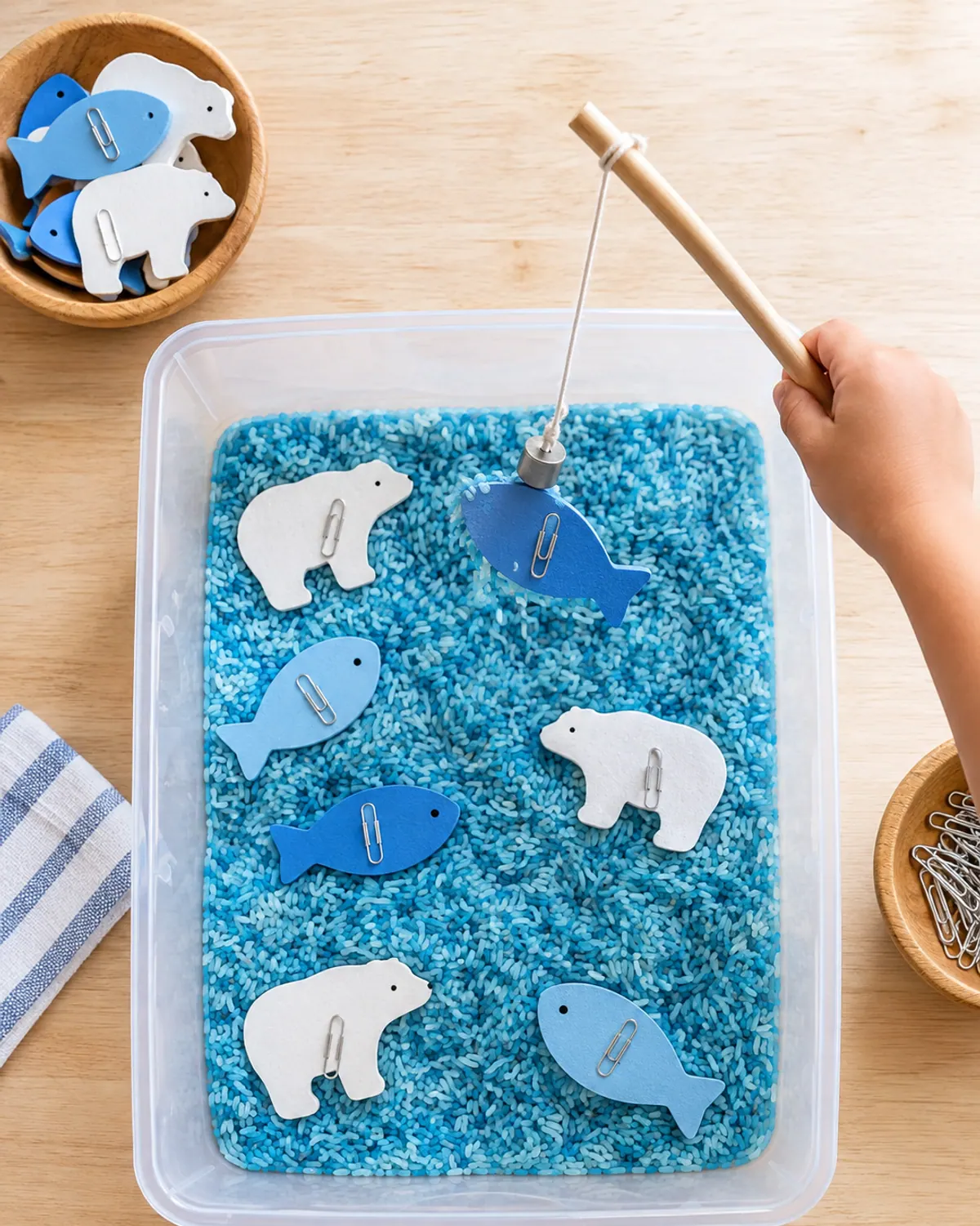
Dye rice blue, or use plain rice, and spread it in a bin like an icy sea. Cut polar bears and fish out of craft foam and slide a paper clip onto each one. Kids catch them with a toy magnet fishing rod and drop each catch into a bowl. Ask them to catch only fish, or three polar bears, for a little counting.
Ages: 3 to 5.
Prep: 15 minutes.
Mess: medium (rice scatters).
Supplies: rice, craft foam, paper clips, a toy magnet fishing rod, two bowls.
Safety: use a rod with the magnet sealed inside a plastic case. Loose small magnets are dangerous if swallowed, and paper clips and dry rice are choking hazards for kids who still mouth things, so supervise closely.
- Write numbers on the foam fish for kids who are ready to count.
6White bean and pinecone forest
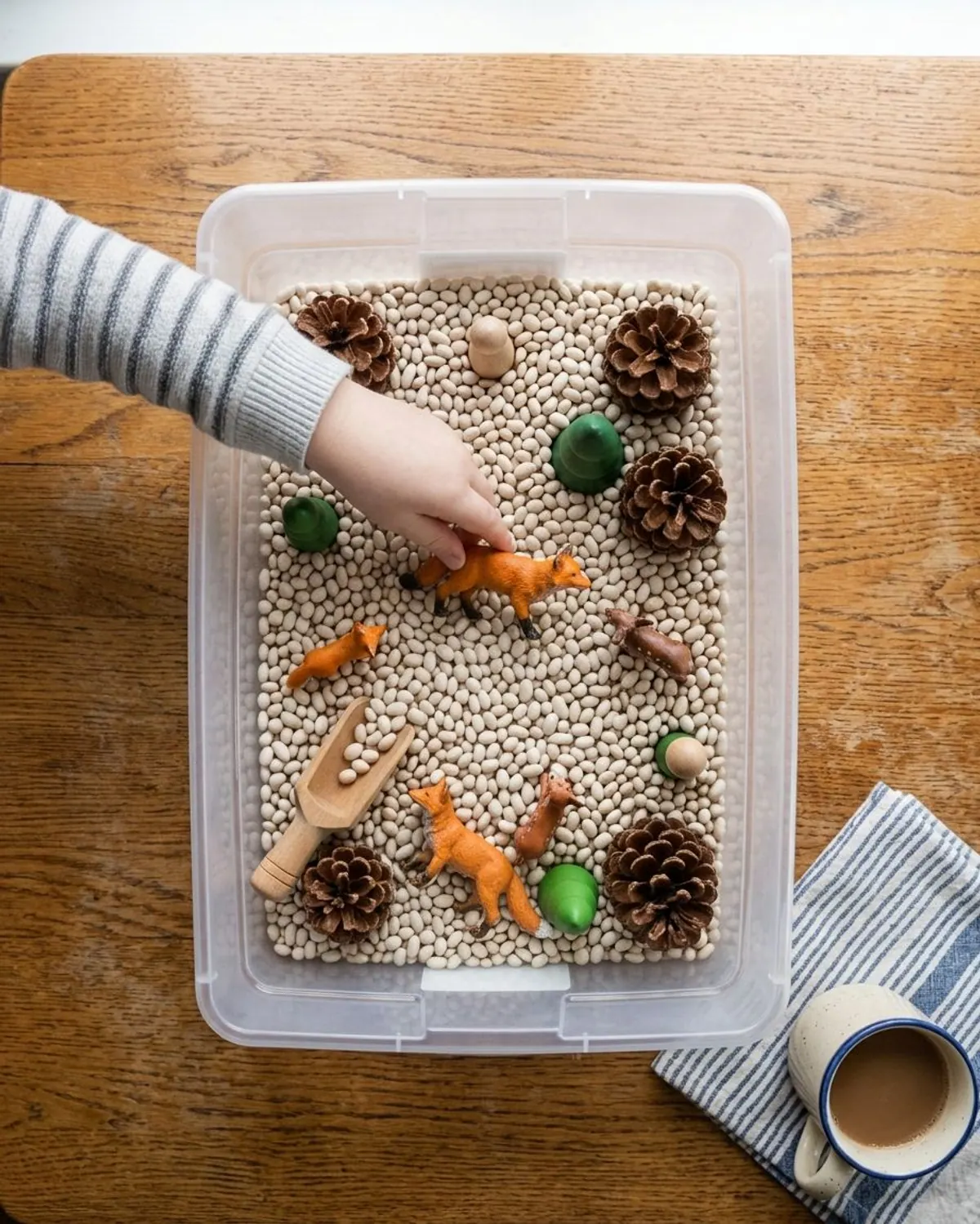
Pour dried white navy beans into a bin as snow, stand real pinecones up like trees and add wooden peg trees and woodland animals. Kids build a snowy forest, move a deer and a fox through it and scoop beans into the pinecone gaps. Beans make a great pouring sound and feel heavier than rice.
Ages: 3 to 6.
Prep: 5 minutes.
Mess: medium.
Supplies: a bag of dried white beans, pinecones, toy woodland animals, a scoop.
Safety: dried beans are a choking hazard and can be pushed into noses and ears, so this is a 3 and up bin with a grown-up nearby. Shake pinecones outside first to remove bugs and loose bits.
- Bake washed pinecones on a tray at a low heat to dry them out before play, with an adult doing the oven part.
7Epsom salt sparkle snow
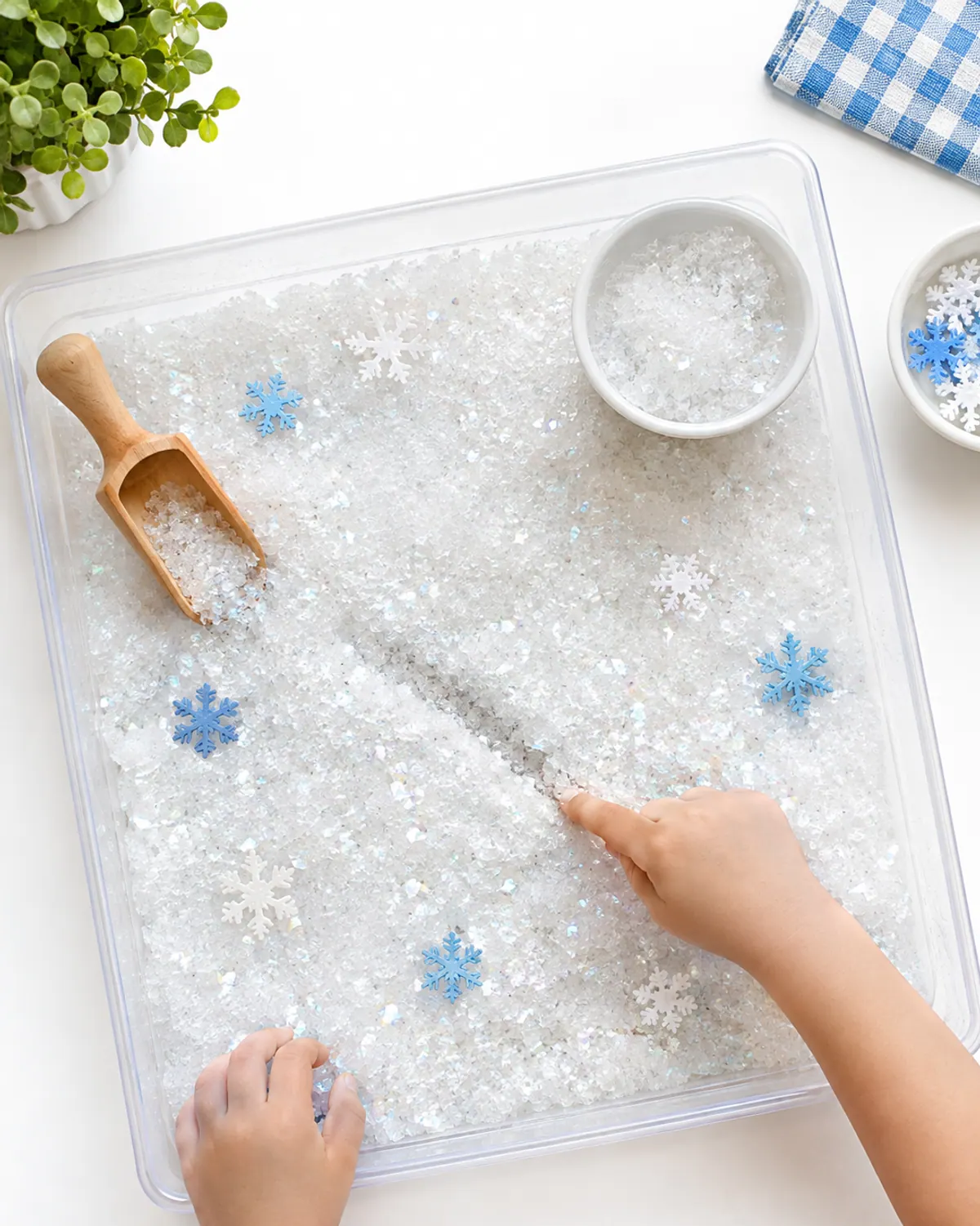
Epsom salt looks like glittering ice crystals. Pour it into a shallow tray, add foam snowflakes and a scoop, and let kids scoop, pour and draw lines with a finger. A few drops of blue food coloring shaken in a bag gives icy blue snow.
Ages: 3 to 6.
Prep: 5 minutes.
Mess: medium.
Supplies: a bag of Epsom salt, foam snowflakes, a scoop, a tray.
Safety: Epsom salt is not taste safe and can sting eyes and small cuts, so skip it for kids who mouth things or rub their eyes, and wash hands after play.
- Add a small mirror under part of the salt so it sparkles more.
Winter Sensory Bins for Kindergarten (Letters and Counting)
Kindergarteners love a bin with a mission. These hide letters, numbers and words in the snow so a little learning comes along with the play. For more ideas like these, see our learning activities for toddlers and preschool activities at home.
8Snowball letter hunt
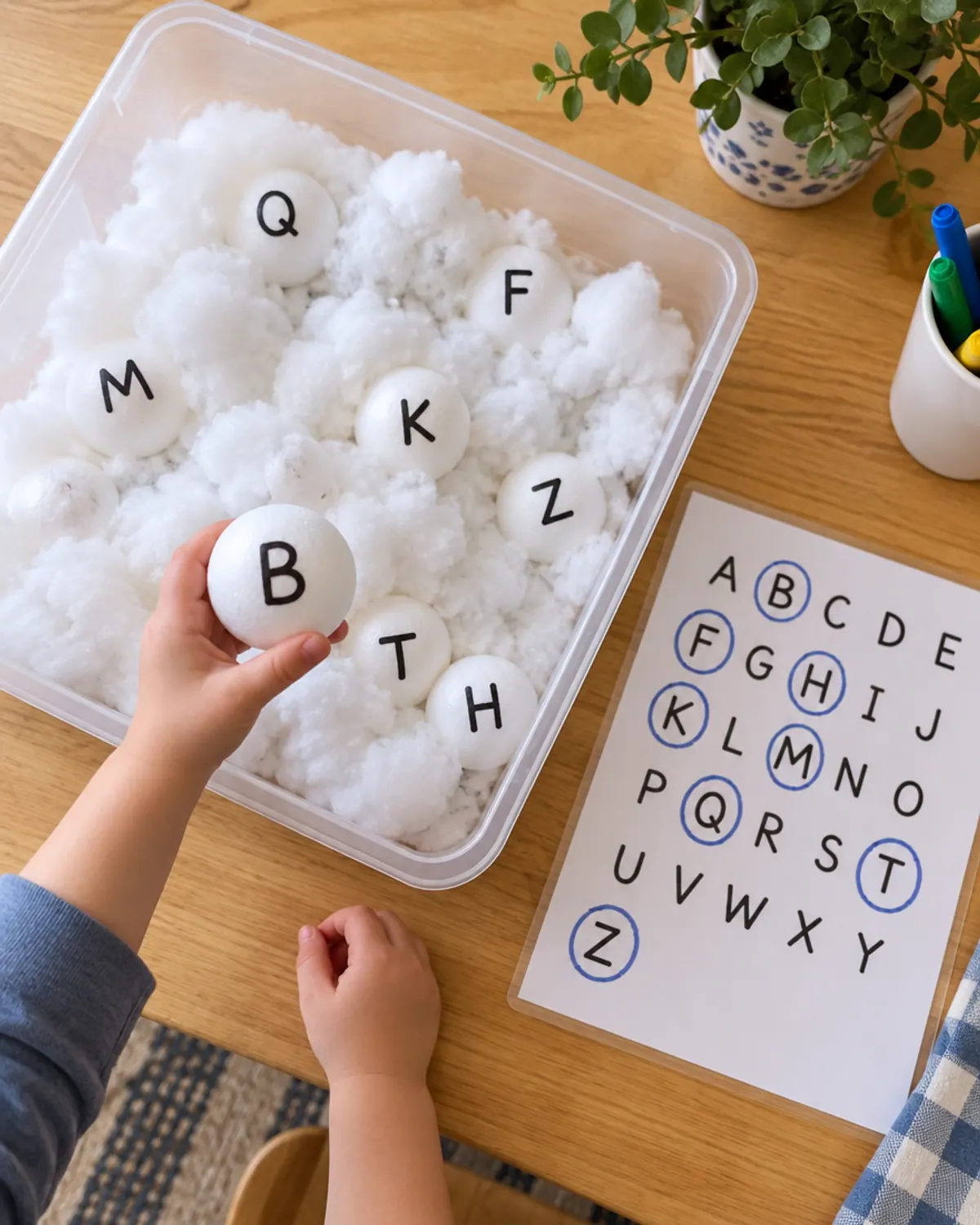
Write letters on ping pong balls or foam balls with a marker and bury them in a bin of cotton batting or cotton balls. Kids dig out a snowball, say the letter, then circle it on a simple alphabet sheet. Use their name letters first, then the whole alphabet.
Ages: 4 to 6.
Prep: 10 minutes.
Mess: low.
Supplies: ping pong or foam balls, a permanent marker, cotton batting, a paper alphabet sheet and a crayon.
Safety: ping pong balls are fine for this age, but keep them away from younger siblings under 3, since small balls are a choking hazard.
- Write lowercase on one side and uppercase on the other for a matching game.
9Cotton ball ten frame
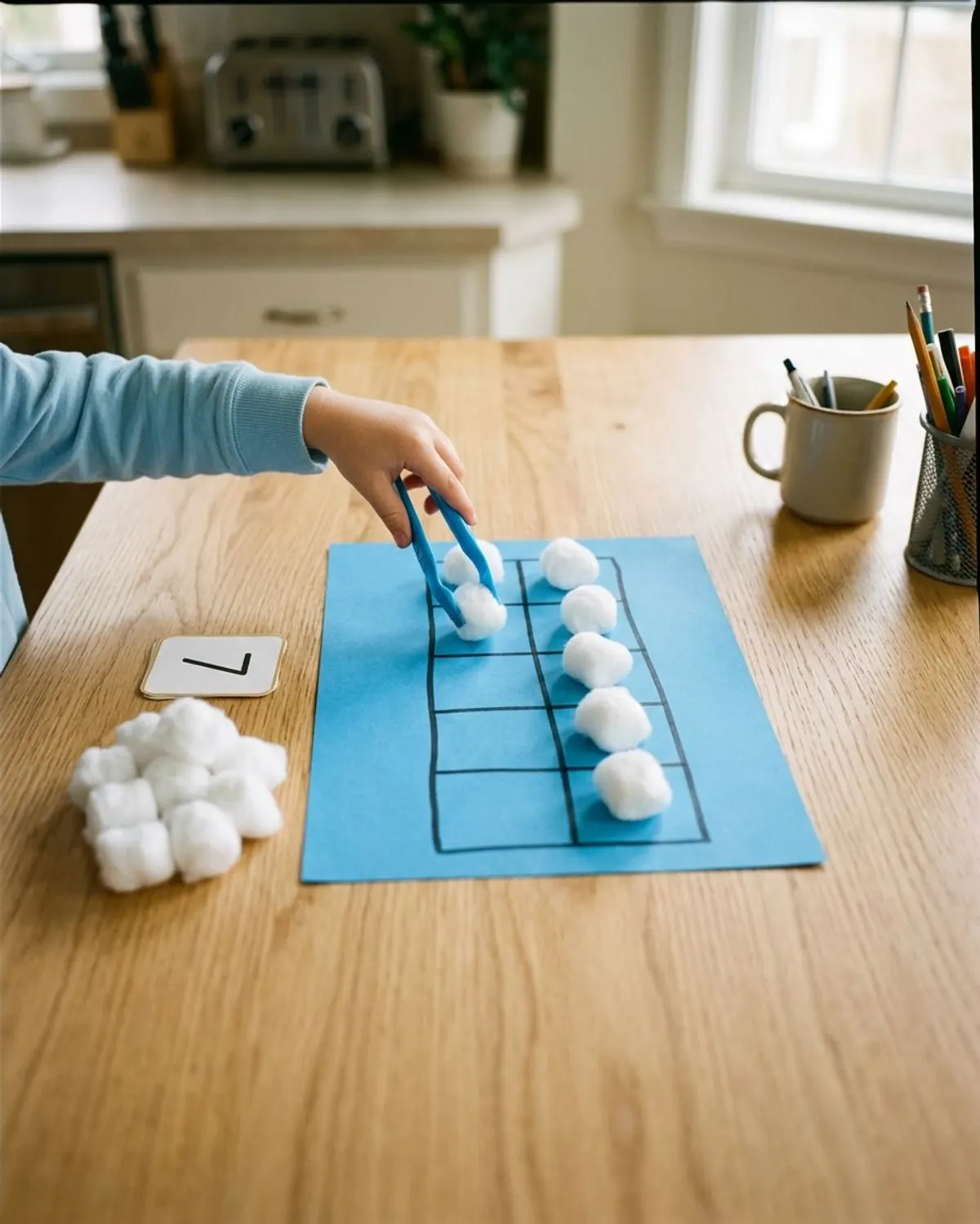
Draw a ten frame on a sheet of blue paper, set a number card next to it and give kids a pile of cotton balls and a pair of tongs. They read the number and use the tongs to put that many snowballs on the frame. Clear the frame and draw a new card.
Ages: 4 to 6.
Prep: 5 minutes.
Mess: none.
Supplies: blue paper, a marker, cotton balls, kid tongs, number cards 1 to 10.
Safety: cotton balls can be a choking hazard for younger siblings, so put them away after play.
- For a challenge, ask how many more snowballs it takes to make 10.
10Snowflake sight word dig
Write sight words or short words on foam snowflakes and hide them in a bin of white rice. Kids dig one out, read it and pop it into a cup. Give a point for each word read, and they can keep digging until the bin is empty.
Ages: 5 to 7.
Prep: 10 minutes.
Mess: medium (rice scatters).
Supplies: foam snowflakes, a marker, a bin of white rice, a scoop, a cup.
Safety: dry rice is a choking risk for kids who still mouth things, so keep this bin away from toddlers.
- Swap words for simple math facts once reading gets easy.
Arctic Small World Bins
A small world bin is a little scene that kids play in with toy animals. These three build a winter wonderland sensory bin that kids come back to day after day.
11Arctic and forest animal sort
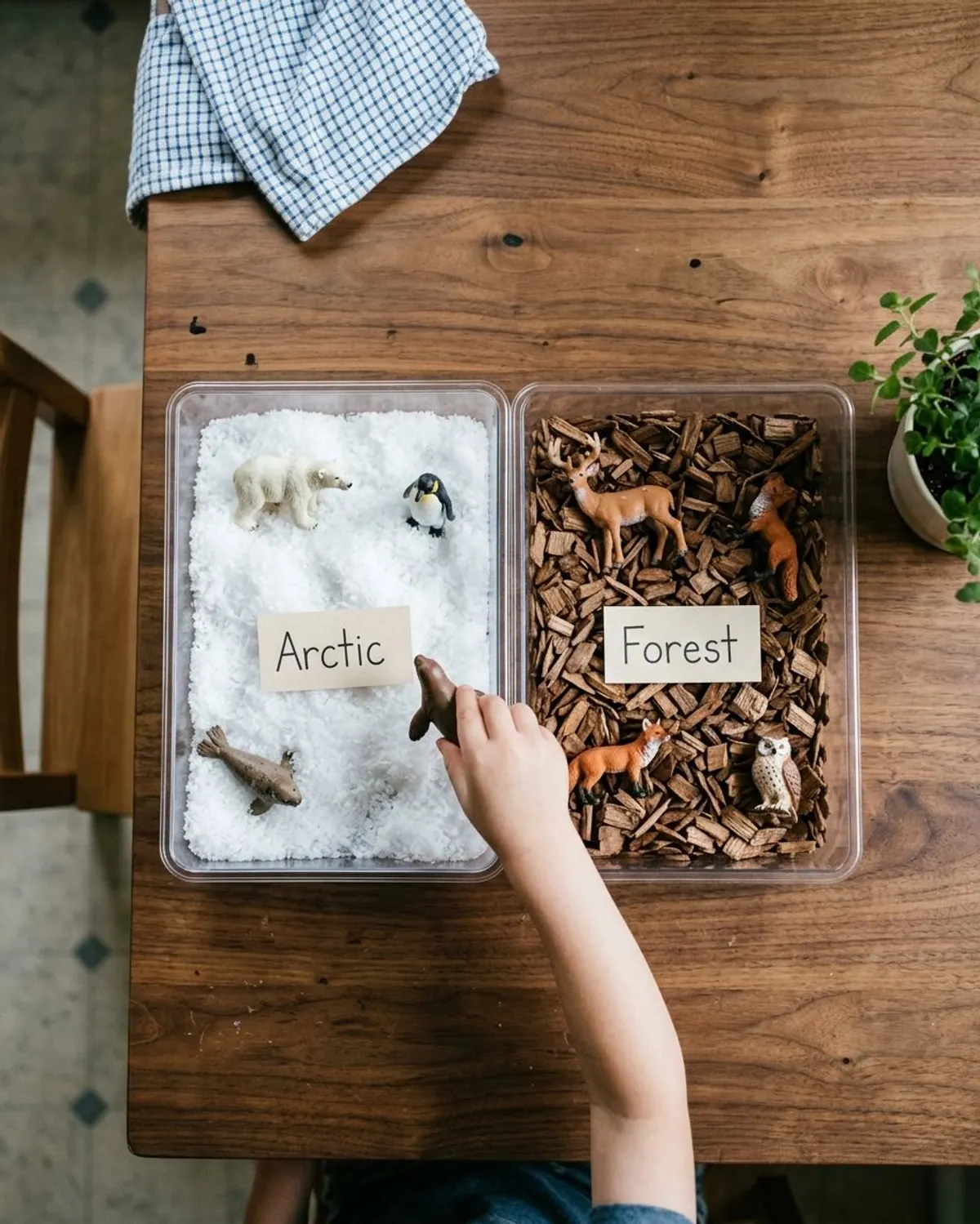
Set two trays side by side: one with white fake snow labeled Arctic and one with wood chips or brown paper labeled Forest. Mix up the animal figures and ask kids to give each animal its home. Polar bears and penguins go in the snow; deer, fox and owl go in the forest. Ask why they chose each one.
Ages: 3 to 6.
Prep: 10 minutes.
Mess: medium.
Supplies: two shallow trays, fake snow, wood chips or shredded brown paper, mixed animal figures, two paper labels.
Safety: use figures bigger than a toilet paper tube is wide around kids under 3, and check wood chips for splinters.
- Penguins live near the South Pole and polar bears near the North Pole. Older kids can split the arctic tray into two ends.
Polar bears, penguins and seals sized for small hands, used in half the bins on this list.
12Penguin ice slide
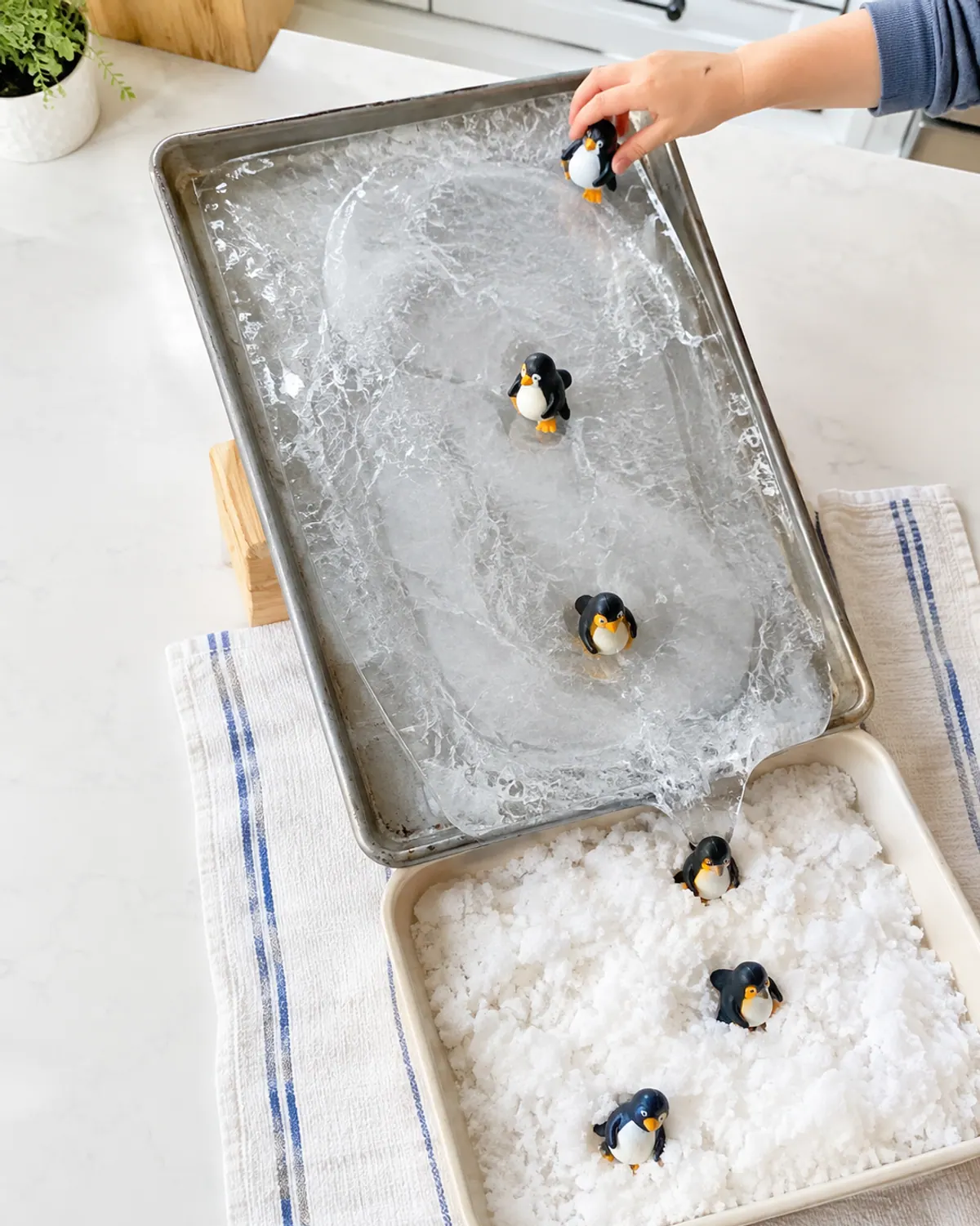
Freeze water in a sheet pan overnight. Prop one end on a small block so the ice makes a slope, and set a tray of snow or ice at the bottom. Kids send toy penguins down the slide and race them. Try sliding them on their bellies, then standing up, and see which is faster.
Ages: 3 to 7.
Prep: 5 minutes, plus freezing overnight.
Mess: medium (it melts as you play).
Supplies: a rimmed sheet pan, water, a small block or book, toy penguins, a tray of snow.
Safety: keep the slope low and steady so the pan can't tip, and dry hands often. Ice is cold, so give mitten breaks.
- Sprinkle a little salt on one lane to see if it slows the penguins down.
13Iceberg ocean bin
Freeze water in a few plastic food containers to make icebergs, then float them in a bin of cool water with a drop of blue coloring. Add arctic animals and let kids balance seals and polar bears on the icebergs, push them along and watch them slowly shrink.
Ages: 3 to 6.
Prep: 5 minutes, plus freezing overnight.
Mess: high (water).
Supplies: plastic containers, water, a bin, blue food coloring, arctic animal figures, a towel.
Safety: never leave a child alone with any amount of water, even a shallow bin. Lay a towel underneath and wipe up drips so no one slips.
- Freeze some icebergs with a tiny toy inside for a slow rescue.
A shallow, wide bin keeps the filler in and the lid saves the setup for tomorrow.
Ice Science Winter Sensory Bins
Ice is free, it is cold, and it changes as kids watch. These bins mix play with a little science.
14Salt and color ice melt tunnels
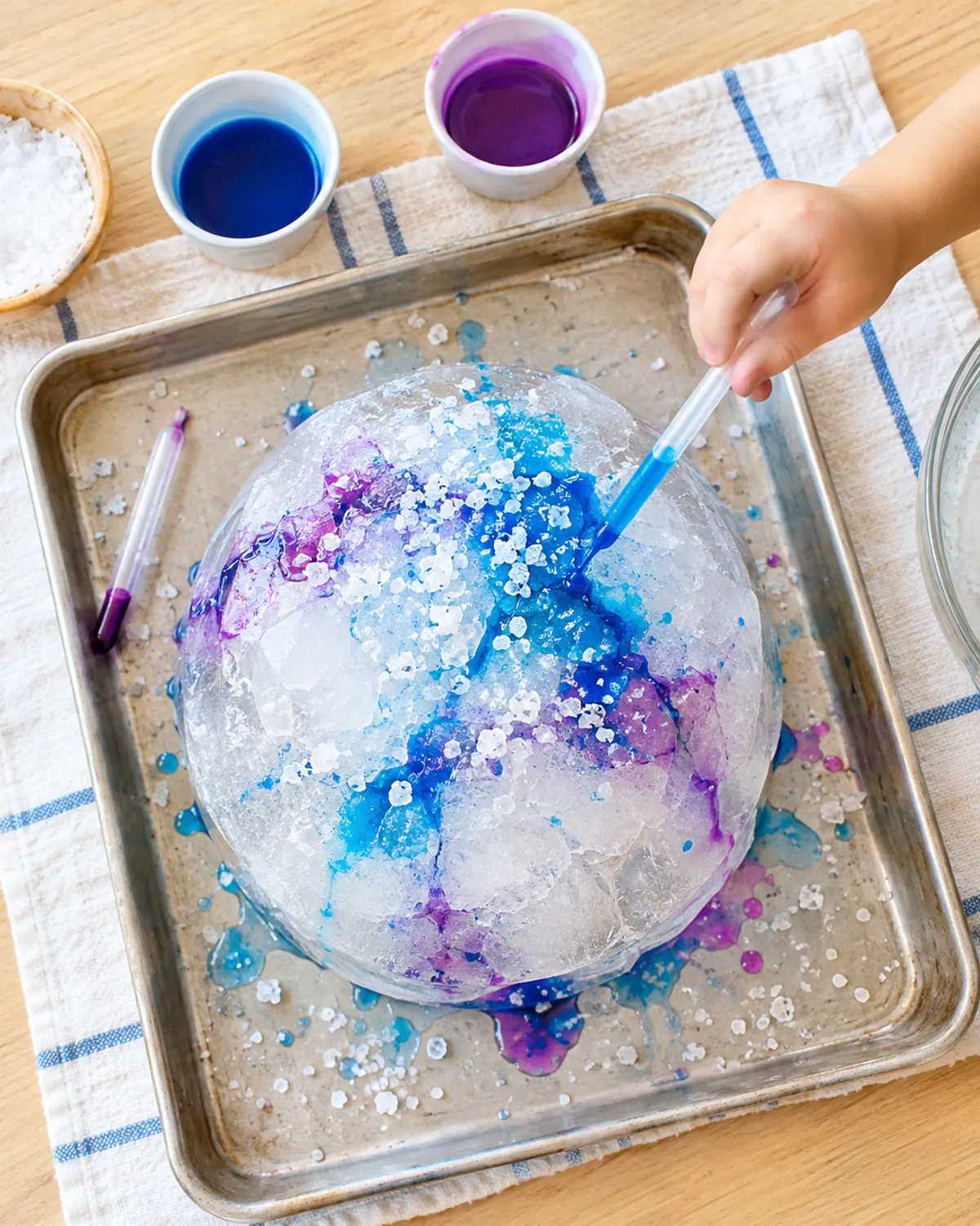
Freeze water in a big bowl overnight and turn the ice dome out onto a rimmed tray. Kids sprinkle coarse salt on top and watch tiny tunnels and cracks appear, then drip liquid watercolor or colored water into the cracks with pipettes. The color spreads through the tunnels like veins in a crystal.
Ages: 4 to 8.
Prep: 5 minutes, plus freezing overnight.
Mess: high (color stains; use a tray and old clothes).
Supplies: a big bowl, water, coarse salt, liquid watercolor or food coloring, pipettes, a rimmed tray.
Safety: salt on ice makes it colder, so kids should use pipettes and spoons and not hold salted ice in their hands. Keep salt away from eyes.
- Take a photo every 5 minutes to show how the tunnels grow.
15Colored ice cube painting
Freeze water mixed with washable paint or food coloring in an ice cube tray, with a craft stick in each cube as a handle. Once frozen, kids slide the cubes across thick paper and watch the colors melt into a painting.
Ages: 2 to 6.
Prep: 5 minutes, plus freezing overnight.
Mess: medium to high (color stains).
Supplies: an ice cube tray, washable paint or food coloring, craft sticks, thick paper, a tray.
Safety: use washable paint, and keep cubes on the stick so small hands don't get too cold. For toddlers who mouth, use plain water with a drop of food coloring.
- Put the paper on a tray so the melt water stays put.
Cheap Winter Sensory Bins (Under $5)
A good winter sensory bin doesn't need a shopping trip. These use things from the recycling bin, the pantry or a dollar store, and most cost under $5.
16Shredded paper blizzard bin
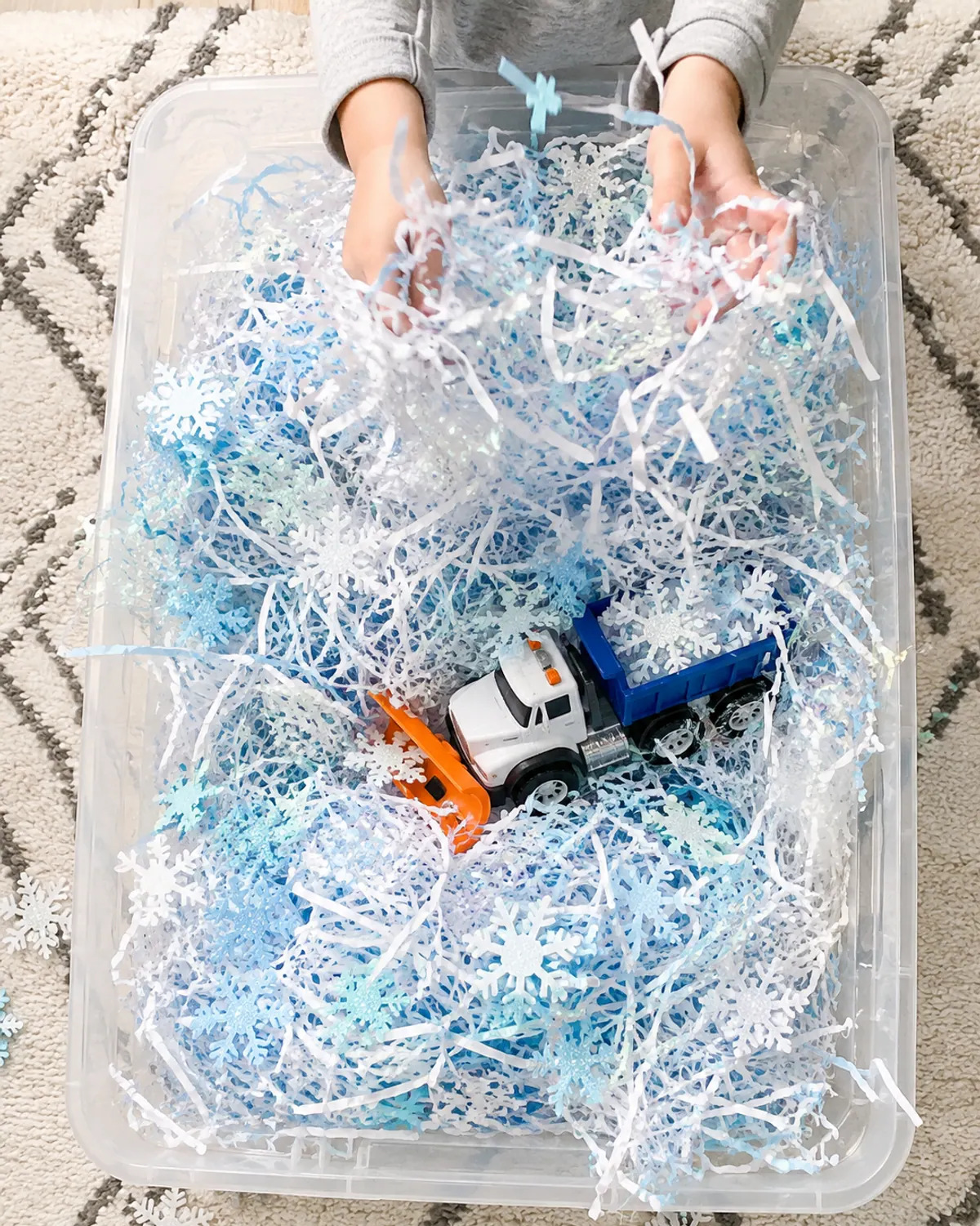
Shred white and light blue paper, or tear it into strips, and fill a big bin. Add paper snowflakes and a toy snow plow or dump truck. Kids toss the blizzard into the air, plow roads and dig for the truck. It is light, quiet and easy to scoop back in.
Ages: 2 to 6.
Prep: 10 minutes.
Mess: medium (it floats everywhere, but it vacuums up).
Supplies: white and blue paper or tissue, a shredder or scissors, paper snowflakes, a toy truck.
Safety: paper strips are not a choking risk for most kids, but watch toddlers who chew paper and keep strips longer than a finger.
- Save packing paper from deliveries for free filler.
17White rice scoop and pour station
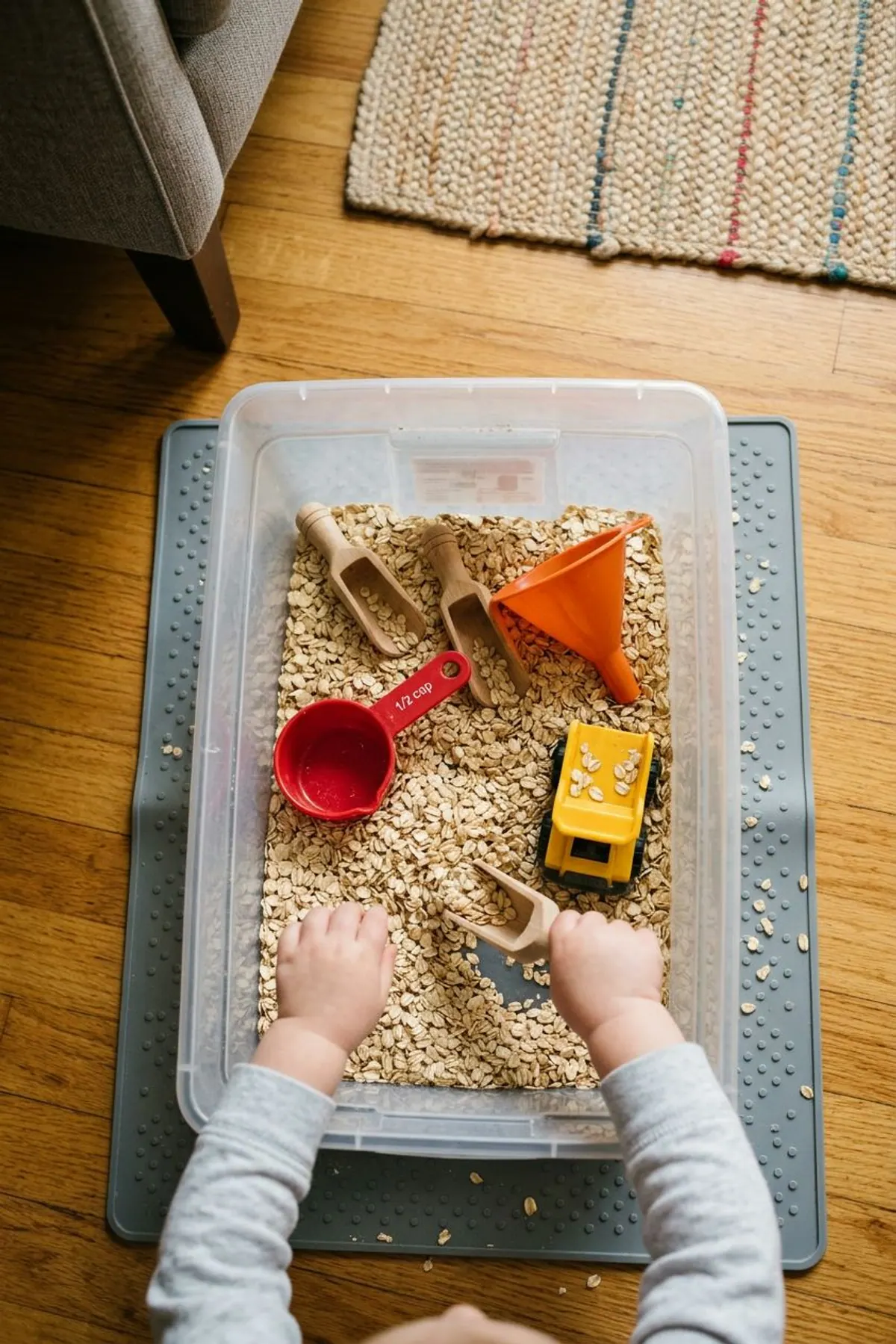
Fill a bin with plain white rice and add measuring cups, a funnel, a muffin tin and a few small bowls. Kids scoop, pour and fill each muffin cup, which is great practice for hand control. Add a few foam snowflakes to find.
Ages: 3 to 6 (2 to 3 with close supervision).
Prep: 2 minutes.
Mess: medium (rice scatters; play on a sheet).
Supplies: a bag of white rice, measuring cups, a funnel, a muffin tin, bowls.
Safety: raw rice is a choking risk for kids who mouth things, so stay close and play on a floor you can sweep.
- Store the rice in a zip bag and reuse it all winter.
Scoops, tongs and funnels turn any filler into fine motor practice.
18Baking soda snow fizz
Mix baking soda with a little water until it holds together like snow. Kids pack small snowmen or snowballs, then spray or drip vinegar on top and watch them fizz and melt away. Make more snow and do it again.
Ages: 3 to 7.
Prep: 5 minutes.
Mess: high (wet and fizzy; use a tray).
Supplies: baking soda, water, vinegar in a spray bottle or cup with pipettes, a tray.
Safety: vinegar stings eyes and baking soda is not for eating, so keep hands away from faces and wash up after. A grown-up handles the vinegar for younger kids.
- Add a drop of food coloring to the vinegar for colored fizz.
19Snowflake play dough tray
Set out white play dough with snowflake and star cookie cutters, a small rolling pin and a few buttons or pinecones for pressing patterns. Kids roll, cut and decorate their own snowflakes. It is a calm, quiet bin for late afternoon.
Ages: 2 to 6.
Prep: 2 minutes.
Mess: low.
Supplies: white play dough, snowflake cookie cutters, a small rolling pin, pinecones or big buttons.
Safety: store bought play dough is not food, so supervise kids who still taste things, and skip small buttons around children under 3.
- Keep the dough in a sealed tub so it lasts all winter.
Setup, Cleanup and Supervision
Every bin on this list needs a grown-up nearby. Use the toilet paper tube rule: if a piece fits through a toilet paper tube, it is small enough to be a choking hazard for a child under 3. The American Academy of Pediatrics also lists foods and small objects to keep away from young children.
Winter sensory bin setup checklist
Rotate bins instead of making a new one every day. Put two away with lids, bring one out, and swap each week so the old ones feel new again. Want something for the rest of the cold season? Our winter activities for kids list has 31 indoor and outdoor ideas, and toddler activities at home fills the gaps between bins.
If December is busy at your house, the printable Christmas pack has a 24-day countdown with one small activity a day, plus I Spy and scavenger hunt pages that pair well with a winter bin.
Winter Sensory Bin Supplies
Winter sensory bin supplies
- Top pick
Instant fake snow powder
Typically $3 to $8
Add water and it puffs into cold, fluffy snow you can reuse for days.
Check price on Amazon for Instant fake snow powder -
Arctic animal figures set
Typically $7 to $9
Polar bears, penguins and seals sized for small hands, used in half the bins on this list.
Check price on Amazon for Arctic animal figures set - Budget pick
Sensory bin scoops and tongs set
Typically $5 to $20
Scoops, tongs and funnels turn any filler into fine motor practice.
Check price on Amazon for Sensory bin scoops and tongs set -
Clear plastic bin with a lid
Typically $5 to $15
A shallow, wide bin keeps the filler in and the lid saves the setup for tomorrow.
Check price on Amazon for Clear plastic bin with a lid
Pick one filler, one theme and three tools, and you have a winter bin ready in 5 minutes. For 50 more screen-free ideas for cold days, grab the free activity cards below.
Frequently asked questions
How do you make fake snow for a sensory bin?
The quickest way is instant snow powder: sprinkle it in a bin, add water and it puffs up in seconds. Baking soda mixed with a little water also makes packable snow. For toddlers, plain potato flakes with a splash of water make a taste safe snow.
What can I put in a winter sensory bin for toddlers?
For ages 1 to 2, use taste safe or large items: potato flake snow, big ice discs with large toys, and a basket of mittens, hats and scarves. Skip rice, beans, cotton balls and small figures until they stop mouthing things.
Is instant snow safe for toddlers?
Instant snow powder is often sold as non-toxic, but it is not food and is not taste safe. Save it for kids who no longer put things in their mouths, usually around 3 and up, wash hands after play and keep it away from eyes.
What is a taste safe snow for a 1 year old?
Plain instant potato flakes with a little water are a good taste safe snow. Real snow brought inside for a short session works too, but it should not be eaten. Stay within arm's reach and keep play to 10 to 15 minutes.
What do you put in a preschool winter sensory bin?
Preschoolers can use instant snow, rice, dried beans or Epsom salt with arctic animals, scoops, tongs and foam snowflakes. Add a mission, like rescuing animals, fishing with a magnet rod or sorting arctic and forest animals.
Save it for later
Pin this to your Sensory Play board so it's there when you need it.
Save to Pinterest